
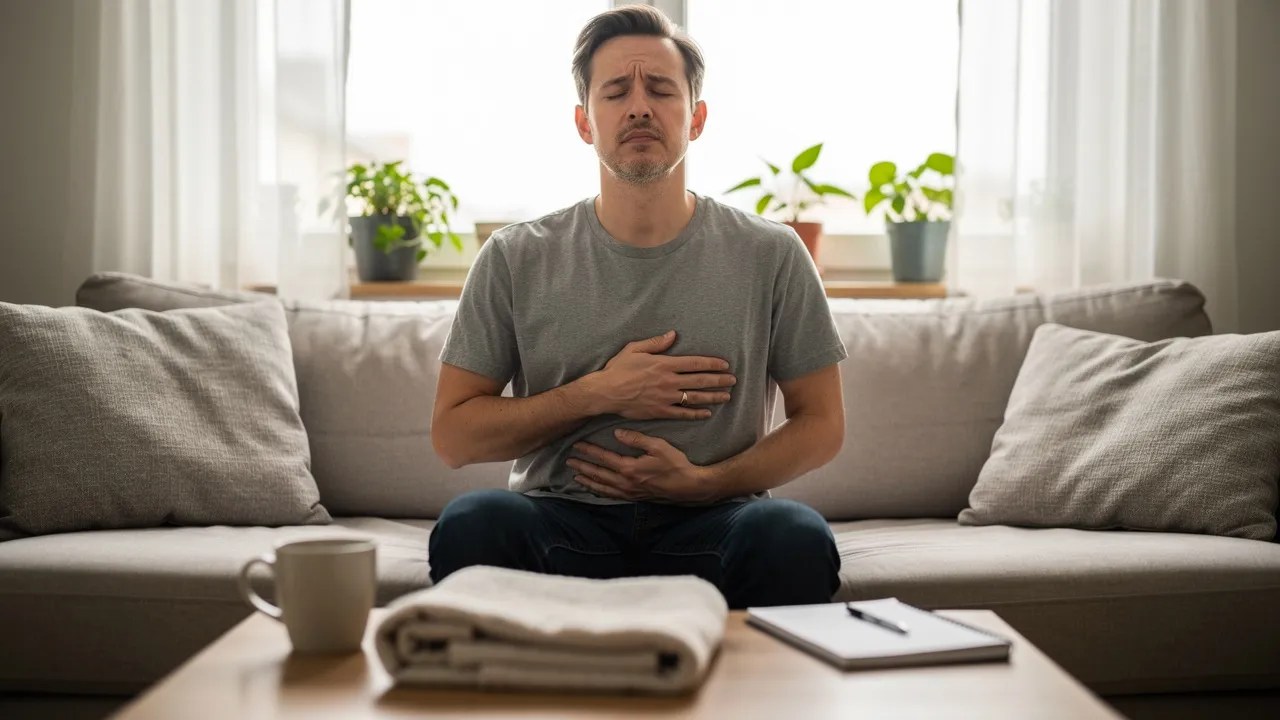
Match the strategy to what anxiety is doing
Anxiety is often sustained, excessive worry about an anticipated future threat that you cannot control. It can affect your daily life, work, relationships, and happiness, and it can last from minutes to days. Coping skills can ground you, interrupt spiraling thoughts, and make anxious moments more manageable, but they do not make anxiety disappear altogether.
Anxiety-management tools are ways to respond to distress, not diagnostic tests. Anxiety disorders involve more than occasional worry or fear: anxiety may not go away, may be felt in many situations, and can get worse over time. Start with the part of the experience that needs attention now, then check whether the strategy changes your thoughts, physical sensations, or ability to take the next ordinary step.
Start with a body-first reset
Body-first tools give you a manageable starting point when anxious thoughts are moving faster than you can sort them. You can try breathing exercises to help you feel calmer and reduce anxiety. You can also count slowly to 10, repeat, and count to 20 if necessary. These actions are small on purpose; you do not need to solve the entire problem before deciding whether the moment has become more manageable.
Sensory grounding brings attention back to what is around you. Try this sequence:
- Name 5 things you can see.
- Name 4 things you can feel physically.
- Name 3 things you can hear.
- Name 2 things you can smell.
- Name 1 thing you can taste.
Afterward, check one concrete sign of change: can you follow the next sentence in a conversation, remain with the task in front of you, or choose what to do next? A smaller amount of spiraling may be enough to continue; you do not need to feel completely calm for the exercise to be useful.
A body-first reset is a trial, not a test you can fail. Notice the effect rather than forcing yourself to continue.

Make worry patterns visible
Journaling can help you and your mental health provider identify what causes stress and what seems to help you feel better. Keep the record simple so it captures patterns rather than becoming another task to perform perfectly. Write down the situation, the thought that appeared, the physical sensation you noticed, what you did next, and whether the next hour became easier or harder.
A daily worry period gives recurring concerns a planned place instead of allowing them to occupy every part of the day. Try this sequence:
- Choose a consistent time and place for worrying.
- Briefly write down worries when they appear during the day.
- Return to the list during the planned period.
- Decide whether each item needs action, a conversation, or no action today.
For example, a worry period could run from 5:00 to 5:20 p.m. in the living room. The example measures a 20-minute period; you can use the structure without treating that exact time as a requirement.
Anxious thoughts can feel like settled facts, especially when your body is already alert. Treat negative thoughts as hypotheses to test rather than facts, and examine them to develop a more balanced perspective. Ask what you know, what you are predicting, what else could happen, and what action is available now. The goal is not to argue yourself into forced positivity; it is to create enough distance to choose a response. One useful distinction is between an observation and a prediction. An observation describes what is known now, while a prediction describes what you fear may happen; keeping those statements separate can make the thought easier to examine. A brief record can also identify repeated avoidance, giving a qualified therapist clearer information about how the pattern affects daily life.
Strengthen the conditions that support coping
Daily conditions can make coping easier to practice. Physical activity may improve your mood and help you stay healthy. A general weekly movement target is at least 2½ hours of moderate-intensity activity, 1¼ hours of vigorous-intensity activity, or a combination of the two; the figures measure total activity time in one week. Start with an amount you can approach without turning movement into another source of pressure.
Supportive routines can include the following:
- Eat well-balanced meals, do not skip meals, and keep healthful, energy-boosting snacks available.
- Make sleep and rest a priority, especially when you are stressed.
- Take a time-out with music, meditation, yoga, massage, or another relaxation technique that helps you step back from the problem.
- Ask a trusted friend or family member for emotional support during a stressful period.
Enough sleep, exercise, a healthy diet, and support from trusted people may help with panic disorder, but healthy habits alone cannot replace treatment. Daily routines can support coping without becoming a demand to do everything at once. Choose one realistic foundation, observe its effect on your ability to function, and add another only when the first feels workable. Getting involved by volunteering or being active in your community can create a support network and give you a break from everyday stress. Anticipating various outcomes may assist in preparing for stress associated with a change or event.
Alcohol and recreational drugs can worsen anxiety, and nicotine and caffeine can worsen anxiety. Limiting alcohol and caffeine may help avoid aggravating anxiety or triggering panic attacks. Using drugs or alcohol to escape problems, help with sleep, or make anxious symptoms go away can cause serious problems and put relationships, jobs, and health at risk. Treat substance use as a signal to seek support, not as a substitute for care.
Change the tool when it is not helping
Personal fit varies across coping strategies. Not all positive coping responses work well for every person, and you may need to try several positive coping strategies to find one or more that work best for you. Compare each attempt with the same few questions: did distress become more manageable, could you return to an ordinary activity, and did the strategy create a new problem?
A coping strategy may lose effectiveness when it becomes routine, stale, or boring through repeated use. Some coping strategies may run their course and lose impact; adapting or changing them can create an opportunity to try another healthy strategy. Shorten the exercise, change the setting, pair it with support, or replace it with a different option. If a strategy increases distress, makes you feel less in control, or keeps you stuck, pause it rather than pushing through. Use the same kind of check each time rather than judging a strategy by whether it creates complete calm. A useful result may be a modest change, such as returning to a task or making a decision without adding another avoidance pattern. If no useful change appears across attempts, that result is information about fit, not evidence that you have failed. Anyone who becomes more distressed or feels unsafe should contact a qualified professional promptly instead of continuing to experiment alone.
Social avoidance deserves a separate check. Avoiding other people can make you feel isolated and increase feelings of sadness and fear, while social support is important to healthy coping. Choose a low-demand connection, such as sending a brief message or asking someone to sit with you, when a large social plan feels unrealistic. If isolation keeps growing, move from self-management toward qualified support.
Recognize when self-management should give way to help
Persistent anxiety deserves more than an endless cycle of self-management. Consider professional help when anxiety persists, disrupts sleep or daily life, leads you to avoid normal activities, or makes you feel unsafe. Frequent palpitations, muscle tension, stomach upset, headaches, dizziness, or shortness of breath may also be signs that it is time to get help. Professional treatment is indicated when anxiety causes marked distress or complications.
Chest pain, severe shortness of breath, fainting, new confusion, or neurologic symptoms should be treated as an emergency when severe, sudden, or unfamiliar, not as routine anxiety. If anxiety comes with thoughts of self-harm or suicide, or you cannot function in daily life, seek immediate help by calling 988 or going to the nearest emergency room.
Treatment for anxiety disorders may involve psychological therapy, medication, or a combination of both. Avoid using alcohol or drugs to manage symptoms, and do not let a temporary reduction in discomfort hide a worsening pattern.
Long-term figures describe groups, not a prediction about your course. In an analysis of eight randomized controlled trials on CBT for anxiety disorders, 48% of patients were still symptomatic after 2 to 14 years of follow-up; the percentage measures patients who remained symptomatic across those eight trials. In separate relapse-prevention studies, around 40% of patients randomized to placebo relapsed after responding to open drug treatment for 8 to 12 weeks and then receiving long-term treatment for 24 to 52 months; the percentage measures relapse in the placebo group under those study conditions. A clinical review recommends continuing medications for 6 to 12 months after remission, which is a treatment decision rather than a self-management target.
Understand what qualified therapy can add
Cognitive-behavioral therapy uses interventions and techniques that promote more adaptive thinking and behaviors to reduce distressing emotional experiences. CBT considers how thinking patterns, distressing feelings or physical experiences, and unproductive behaviors can interact and reinforce anxiety over time. That framework can help you and a therapist identify where anxiety is being maintained and choose a structured focus for treatment. Anxiety concerns can overlap, so a unified CBT approach focuses on mechanisms shared across related anxiety disorders rather than treating every presentation as unrelated. A unified CBT approach is supported by commonalities among anxiety disorders and their high levels of comorbidity. The Unified Protocol is described as the most studied transdiagnostic treatment for anxiety disorders, with cited evidence showing equivalent efficacy to disorder-specific protocols. This information can help an adult ask whether a proposed therapy plan addresses the patterns affecting daily life, without treating a general framework as a diagnosis or individualized treatment plan.
Avoidance of feared experiences, events, and thoughts can contribute to prolonged anxiety. In therapy, exposure exercises are designed to confront a feared situation without avoidance or subtle safety behaviors. Repeated exposure can help you learn that the situation is less likely to have disastrous outcomes. Exposure Response Prevention is a psychotherapy for specific anxiety disorders such as phobias and social anxiety; it aims to help you develop a more constructive response to fear and effective coping strategies.
CBT approaches can be tailored to specific anxiety presentations, including panic disorder, specific phobias, and social anxiety disorder. CBT is often structured and manualized. Sessions often occur weekly for a limited period, such as 12-16 weeks, and a small number of booster sessions are sometimes offered afterward; the 12-16-week figure measures the example treatment period described for weekly CBT sessions.
Adding pharmacotherapy to CBT may produce short-term benefit, but those improvements diminished during 6-month follow-up in the cited meta-analysis. The six-month period measures the follow-up window, not a promise about how long any particular treatment will work. Ask qualified support to explain the available options when coping tools are not enough.

Explore adult anxiety therapy options in Denver
The Emerald Couch specializes in treating trauma and anxiety in adults and serves adult clients only. We provide therapy for trauma, anxiety, including OCD and phobias, and depression. The Emerald Couch does not treat younger children.
We offer face-to-face counseling and telehealth therapy in Denver. We co-create goals with you and identify what success looks like for you, so the conversation can stay connected to the daily concerns you want to address.
Our therapy includes learning new coping mechanisms and skills to manage stress, anxiety, or other challenges. That skills-focused work can give you a way to discuss what you have tried, what changed, and where anxiety continues to interfere. Our out-of-network rate for therapy is $220 a session; that figure measures the stated fee for one out-of-network therapy session.
Use an initial conversation to describe whether anxiety, panic, OCD, phobias, or related concerns are affecting your daily life and to discuss the format that fits your circumstances. In-person and telehealth options provide two ways to begin that conversation. Bring your pattern notes if you have kept them; they can help make the concerns and goals more concrete.
Choose your next supported step
If you are an adult considering support for anxiety, OCD, or phobias, The Emerald Couch offers adult therapy in person or by telehealth, beginning with an intake and collaborative goals.
Sources
- Cognitive-Behavioral Treatments for Anxiety and Stress-Related Disorders - pmc.ncbi.nlm.nih.gov
- Anxiety disorders - Diagnosis and treatment - mayoclinic.org, 2025-07-29
- Anxiety, Stress or Burnout: When to Get Help | Hoag Hospital - hoag.org
- Tips and Strategies to Manage Anxiety and Stress - adaa.org
- How to Stop Worrying and End Anxious Thoughts - helpguide.org
- Countdown to take control of anxiety - mayoclinichealthsystem.org, 2023-07-13
- Coping Skills: Anxiety | Worksheet | Therapist Aid - therapistaid.com, 2018-10-17
- Anxiety self-help guide - nhsinform.scot
- Panic Disorder: What You Need to Know - nimh.nih.gov
- 13 Coping Skills for Anxiety That Actually Work - springhealth.com
- Treatment of anxiety disorders - pmc.ncbi.nlm.nih.gov
- Anxiety Disorders - nimh.nih.gov
- Coping Mechanisms - Seattle Anxiety Specialists - Psychiatry, Psychology, and Psychotherapy - seattleanxiety.com
- Anxiety Disorders | NAMI - nami.org