

Map the situations agoraphobia is changing
Agoraphobia-related difficulties can involve panic, fear, or avoidance in particular settings, and agoraphobia can also occur without panic disorder. For an initial treatment conversation, focus on the pattern in your own life: where you avoid going, what becomes harder to do, and which activities you want to reconsider. You do not need to settle on a diagnosis or therapy label before asking for professional help.
If anxiety is limiting errands, travel, work, appointments, social plans, or time away from home, a professional evaluation is a reasonable next step. A consultation can help you describe the settings and activities involved, how fear or panic affects them, and what support may fit your circumstances. The first conversation can clarify functional goals without requiring a treatment decision.
Organize your notes around the pattern you want to understand:
- Settings and activities: Note places, routes, travel, errands, appointments, or time away from home that bring fear, panic, or avoidance.
- What the pattern changes: Record activities you have postponed, altered, or abandoned and the effect on daily life.
- What you want to ask: Include how a therapist would discuss goals, possible approaches, session format, availability, and cost.
This gives an initial conversation a concrete starting point. A qualified professional can ask follow-up questions and assess what is happening without requiring you to reach a conclusion on your own.
At The Emerald Couch, we work exclusively with adults. If you are an adult in Denver or a nearby area and anxiety or phobia-related concerns are affecting daily activities, you can use an initial conversation to explore whether professional support fits your needs.
What treatment is meant to help you evaluate
Agoraphobia can occur on its own or alongside panic disorder. A clinical source reports that about a third of people with agoraphobia also have panic disorder, while agoraphobia can occur without panic disorder. That distinction matters because your treatment conversation should begin with your actual experiences rather than an assumption about why you avoid a place or activity.
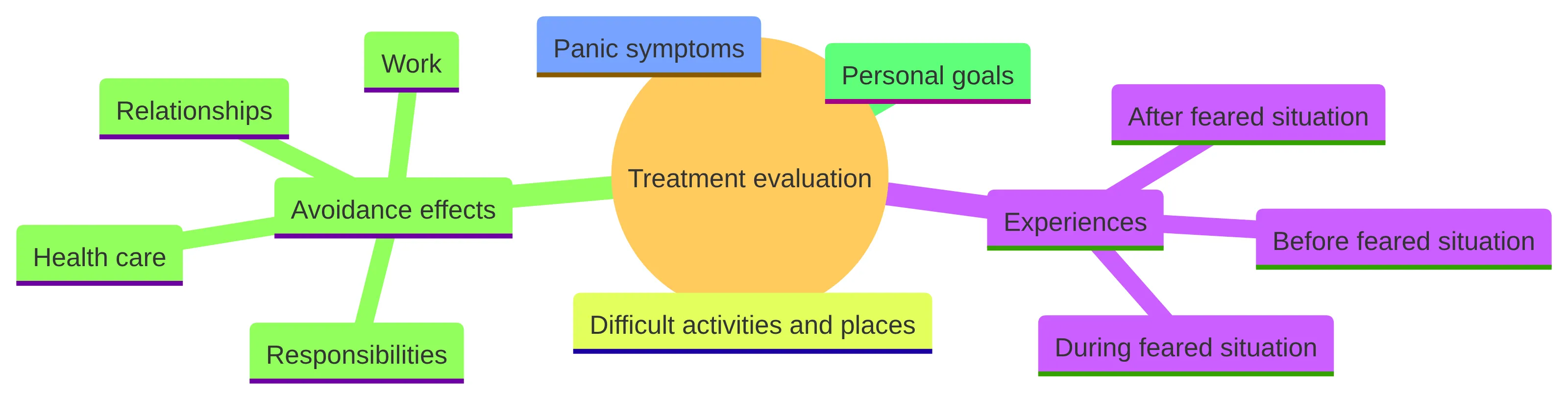
An evaluation can help organize several parts of your situation:
- what happens before, during, and after a feared situation;
- whether panic symptoms are part of the experience;
- which activities, places, or forms of travel have become difficult;
- how avoidance affects work, relationships, health care, or other responsibilities; and
- what you want to be able to do with more flexibility.
These points give you and the therapist a shared starting place. They do not require you to determine the severity or cause of your symptoms before you seek help.
To make that starting place more precise, connect each difficult setting with the pattern around it. You might note whether the difficulty appears when leaving home, traveling, entering a particular place, or anticipating the situation; then note whether panic symptoms, fear, or avoidance is most prominent in what you notice. You can also describe the practical consequence: a missed appointment, a changed route, a postponed errand, or a reduced social plan. This does not label the experience for you. It gives the therapist a clearer account of the feared settings, the response you notice, and the functional goal you want to discuss.
Treatment goals are personal and practical. You may want to attend appointments, use public transportation, leave home for longer periods, return to social activities, or make decisions with less fear controlling the process. You may have a different goal entirely.
A useful consultation makes the goal specific enough to discuss without turning it into a promise about the outcome. You can ask how a therapist would understand your concerns, how goals would be revisited, and how you would talk about changes over time. The conversation should give you a clearer sense of the proposed direction before you decide whether to continue.
Try to phrase a goal so it links an activity with the flexibility you want. “Return to social activities” identifies a life area; adding the situation that makes it difficult and the change you hope to discuss gives the consultation more to work with. The same applies to appointments, travel, or time away from home. A goal stated this way does not predict a result or require a particular therapy. It helps you ask whether the therapist’s proposed approach addresses the pattern you described and whether the plan can be revisited as you learn more.
A review of anxiety treatment reports comparable efficacy across telehealth and face-to-face therapy and describes cognitive behavioral therapy, acceptance and commitment therapy, exposure therapy, and mindfulness-based interventions as adaptable to both formats. That finding addresses the delivery format, not your individual suitability for a particular approach.
You can therefore treat format as part of the treatment question from the beginning. Consider where you can speak openly, what makes attending possible, and which setting supports a consistent conversation about your goals.
What the evidence supports—and what it does not settle
For adults with panic disorder with or without agoraphobia, a Cochrane review reports that talking therapies are generally more effective than no treatment. The same review found no strong evidence that one talking therapy is superior to the others for this group.
This gives you two useful conclusions. Professional talking therapy is a reasonable category of support to discuss, and the research does not justify choosing a therapy solely because someone presents it as universally superior. The studies concern groups of adults, so they cannot determine which approach fits your history, goals, access needs, or preferences.
A network meta-analysis reached a similar boundary: it found no high-quality, unequivocal evidence that one psychological therapy is best for adults with panic disorder with or without agoraphobia. Cognitive behavioral therapy was among the most extensively studied approaches in that analysis, but the conclusion did not establish a universal winner.
You can use this uncertainty constructively. Instead of asking only which label has the strongest reputation, ask how the therapist connects the approach to your concerns, how your goals will shape the work, and how you can discuss whether the plan remains workable.
Translate that evidence boundary into questions about the panic, avoidance, or restricted activities you want to discuss. You might ask what part of your experience the proposed treatment is meant to address, how you and the therapist would define meaningful change in the goals you discuss, and how the plan could be adjusted if its approach, pace, or format did not fit your needs.
Describing what has become difficult keeps the discussion connected to your goals without asking the research to choose a therapy for you.
Why CBT and exposure therapy may come up
CBT and exposure therapy may come up because a clinical guideline reports substantial clinical confidence in both approaches for panic disorder. The guideline describes CBT as supported by multiple positive randomized controlled trials and exposure therapy as well studied and recommended with substantial clinical confidence.
That evidence helps explain why a therapist may discuss these terms when panic-related fear or avoidance is part of the conversation. It does not mean that either approach is automatically appropriate for you, and it does not tell you what a therapist would do in your specific situation.
The result compares treatment categories in research studies; it does not provide an individual treatment instruction.
You can ask a therapist to translate a broad approach into plain language. If exposure therapy is discussed, ask how the therapist describes its purpose, how your concerns would influence the plan, how you can raise questions, and how progress would be discussed. Those questions can help you understand the proposed work without having to agree to it before you have enough information.
Listen for whether the answer distinguishes the broad therapy category from the work proposed for your concerns. A clear explanation might identify the problem the approach is intended to address, the role you would have in discussing goals, and how questions or concerns could be raised. If the explanation assumes that a label alone answers your questions, ask for a more concrete description. That distinction can make an initial consultation more informative without turning general education into individualized clinical advice.
A therapy label is only one part of the decision. Your goals, the therapist’s experience with the concerns you want to address, the clarity of the explanation, the session format, and your ability to keep attending all belong in the same conversation.
You can write down the terms you hear and ask what each term means in the proposed plan. General information about CBT or exposure therapy cannot substitute for an evaluation of your circumstances, so keep the discussion connected to what you want help with.
Read the evidence through the pattern you want to change
The evidence was not uniformly strong: confidence ranged from very low to moderate, no psychotherapy had high-quality evidence, and some therapies with strong efficacy estimates were less acceptable to participants.
These findings put two ideas side by side. A therapy can perform well in a study comparison, while the experience of starting or continuing it may not be equally workable for everyone. Research results and your ability to understand, discuss, and remain engaged with a plan are related questions, not interchangeable ones.
No high-quality, unequivocal evidence supports one psychological therapy over another for adults with panic disorder with or without agoraphobia. Use that finding as a boundary rather than as a ranking.
In a consultation, ask how the proposed approach relates to:
- the settings or activities you avoid;
- the fear, panic, or anticipatory anxiety you notice;
- a functional goal such as attending an appointment, traveling, working, or leaving home;
- how you would discuss whether the plan remains workable; and
- the format and schedule you can realistically attend.
These questions do not predict an outcome or determine which therapy you should choose. They keep the discussion tied to the pattern affecting your life rather than to a general claim about superiority.
A therapist who responds clearly to these questions gives you more information than a treatment name alone. You can ask what the first few sessions would focus on, how goals would be recorded or revisited, and what you should do if the plan does not seem to fit.
If the explanation remains vague, the approach does not match the concerns you brought, or the practical arrangement prevents regular attendance, treat that as a reason to keep asking questions before committing. If the conversation is clear enough to support a considered decision, you can choose whether to continue.
Ask how format affects access to the conversation
Telehealth and face-to-face therapy can both be relevant formats for anxiety treatment. A review reports comparable efficacy across the two formats and describes approaches including CBT and exposure therapy as adaptable to both. That evidence does not determine which format fits an individual situation.
For agoraphobia-related concerns, consider how each setting relates to the pattern you want to discuss:
- whether getting to an office is itself one of the difficulties you want to address;
- whether a private space is available for a remote session;
- whether either format supports regular attendance and open discussion;
- how scheduling, work, caregiving, health, or transportation affect access; and
- what you want to understand about technology or the structure of remote sessions.
Bring those conditions into the conversation so format remains connected to the settings and activities you want to address.
At The Emerald Couch, we offer both face-to-face counseling and telehealth therapy. If you are considering support in Denver, you can include format in your first questions rather than treating it as a detail to resolve later.
You might ask which formats are available for the concerns you want to discuss, how appointments are scheduled, and how the therapist would structure the initial conversation in each setting. You can then weigh the answer against your privacy, travel, schedule, and communication needs.
Format should support the conversation rather than become another reason to postpone it. If leaving home is difficult, telehealth may be a practical topic to raise. If remote sessions are hard to arrange privately or consistently, face-to-face care may be the more useful topic to discuss. You can bring either concern to an initial consultation and ask what options are available.
Questions that connect consultation to daily-life goals
An agoraphobia-focused consultation can begin with the pattern you want to understand rather than a preferred therapy label. The Emerald Couch’s consultation guidance recommends asking about a therapist’s educational background, training, and specialized certifications related to your concerns.
Questions can include:
- What experience do you have with avoidance involving travel, errands, appointments, work, or other settings?
- How would you explain the concerns I describe and the approaches you might discuss?
- If exposure therapy is discussed, what would I be invited to understand and ask about before deciding whether to continue the conversation?
- How would we identify a daily-life goal and revisit whether it remains useful?
- How would we discuss a need to adjust the plan?
- What appointment frequency and session duration do you generally offer?
You do not need to ask every question in one conversation. Start with the question that addresses your main uncertainty about the pattern affecting your life.
A therapist’s skill should relate to the areas you hope to address. The Emerald Couch’s consultation guidance recommends looking for a therapist who is skilled in those areas, so you can ask directly about experience with the concerns you describe.
Your questions can also cover cultural background, identity, family context, disability, work demands, or any past experience of feeling misunderstood in care. A respectful conversation gives you room to explain what matters to you and to ask how those factors would be included in treatment planning.
Appointment frequency and duration are part of the treatment decision. Guidance from The Emerald Couch recommends discussing those policies when considering therapy.
Ask what scheduling options exist, how often sessions are usually arranged, and what happens if you need to change an appointment. The answers help you compare the proposed plan with your work, travel, caregiving, health, and energy. A plan that cannot fit your life deserves discussion before you treat it as your only option.
If more than one setting or activity is difficult, ask how you would decide what to discuss first. You can ask whether the initial focus would be connected to a specific daily-life goal, how other concerns could be brought in later, and how you would know what to revisit in future sessions. These questions do not ask the therapist to promise a sequence or outcome. They help you understand how the consultation could turn a broad concern into a conversation about priorities.
Match access and cost to the pattern you want to address
Evaluate fit by asking whether the proposed care can address the pattern that limits your movement through daily life. Guidance from The Emerald Couch recommends looking for a therapist skilled in the areas you hope to address and discussing appointment frequency and duration.
Consider:
- Can I describe the settings or activities affected?
- Does the therapist explain how the proposed approach relates to those concerns?
- Can the format and schedule support regular conversations?
- Can I ask about cultural identity, disability, family context, or past care experiences?
- Do the payment terms fit the boundary I need to set?
These questions keep the decision tied to your functional goals and access conditions rather than to a general rating of a therapist.
At The Emerald Couch, we are in-network with Aetna and Lyra. Our out-of-network rate is $220 a session.
If insurance or cost affects your decision, place those questions alongside your clinical questions. You can ask how the available format, appointment schedule, and session arrangement connect with the coverage or payment option you are considering. Cost is not separate from access; it is one of the conditions that can shape whether a plan remains possible.
Availability also belongs in the first conversation. Ask about the timing and frequency of appointments, the formats available, and what the initial session is designed to cover. If the arrangement cannot meet your practical needs, say so directly and ask what alternatives within the available options can be discussed.
A clear answer gives you a basis for choosing a next step. It does not require you to begin treatment before you understand the arrangement.
What an initial conversation with The Emerald Couch can clarify
At The Emerald Couch, we specialize in treating trauma and anxiety in adults. We provide therapy for trauma, anxiety including OCD and phobias, and depression.
If your concern involves fear, avoidance, panic-related experiences, or a phobia, you can describe the daily situations you want to discuss rather than arriving with a completed diagnosis. The initial conversation can then focus on whether your concerns fall within the areas we address and what questions should guide the next step.
At your first visit, we conduct a thorough intake session to gather information and assess your needs. We co-create goals with you and identify what success looks like for you.
That process gives you an opportunity to explain what has become difficult, what you want to change, and what you need from the therapeutic relationship. You can bring the question list from this guide and ask about approach, format, session frequency, duration, and cost. The purpose of those questions is to make the conversation specific to your situation.
We provide education, explain our understanding of your situation, and customize scientifically backed treatments. We offer both face-to-face counseling and telehealth therapy.
You can ask us to explain any treatment term in plain language and to connect the proposed work with the goals you have identified. You can also discuss whether in-person or telehealth therapy is more workable for your schedule, privacy, travel, and communication needs.
Your cultural background, identity, relationships, and past experiences with care can be part of what you bring to an initial conversation. If you have concerns about being misunderstood or judged, say so directly and ask how those concerns will be handled. Clear communication about your needs helps you decide whether the conversation feels respectful and useful enough to continue.
Choose a next step tied to the barrier in front of you
Choose the uncertainty that is holding up your next step. It may be how a therapist would discuss the settings you avoid, whether telehealth or face-to-face access is available, or how coverage and cost work.
Bring that question to an initial conversation and use the response to decide whether you have enough clarity to continue. You do not need to decide on a diagnosis or promise a particular outcome before asking for help.
Questions to resolve before discussing agoraphobia treatment
How can I prepare for my first therapy consultation?
To prepare for your first therapy consultation, consider writing down the situations or activities you want to discuss, the effects those concerns have on your daily life, and any specific questions about therapy approaches, session formats, and costs.
What should I consider when choosing a therapist for agoraphobia treatment?
When choosing a therapist, consider their experience with anxiety and phobias, their approach to treatment, how well you can communicate with them, and whether their scheduling and session format fit your needs.
What is the cost of therapy at The Emerald Couch?
The out-of-network rate for therapy at The Emerald Couch is $220 per session. They are also in-network with Aetna and Lyra, which may affect your costs depending on your insurance plan.
Does The Emerald Couch offer telehealth therapy options?
Yes, The Emerald Couch offers both face-to-face counseling and telehealth therapy to accommodate client preferences.
What can I expect during the initial intake session at The Emerald Couch?
During the initial intake session at The Emerald Couch, you can expect a thorough assessment of your needs, a discussion about your concerns, and the co-creation of goals for your therapy.
Sources
- Psychological therapies for the treatment of panic disorder with or without agoraphobia | Cochrane — www.cochrane.org
- Comparative efficacy and acceptability of psychotherapies for panic disorder with or without agoraphobia: systematic review and network meta-analysis of randomised controlled trials | The British Journal of Psychiatry | Cambridge Core — www.cambridge.org
- Psychological therapies for panic disorder with or without agoraphobia in adults: a network meta-analysis - PubMed — pubmed.ncbi.nlm.nih.gov
- Telehealth Versus Face-to-Face Therapy for Treating Anxiety: Evidence-Based Considerations for Clinicians — behavioralhealthnews.org
- What Is Agoraphobia? — my.clevelandclinic.org
- The Emerald Couch
- Key Questions for Your Consultation with a Therapist, Counselor, or Psychologist — The Emerald Couch
- Finding the right therapist for your needs — The Emerald Couch