

Is this anxiety-therapy option relevant to you?
Choosing anxiety therapy in Denver is a fit decision, not a diagnosis. If you are an adult looking for help with anxiety or a related concern, start by comparing four practical points: whether the stated focus matches what you want to address, whether the care approach feels appropriate, whether the format works with your life, and whether the current access and payment details are workable.
The Emerald Couch provides therapy for trauma, anxiety, including OCD and phobias, and depression. That list describes the concerns we say we address; it does not determine whether therapy with us is suitable for your particular situation or promise a specific result. Use it as a starting point for questions you can bring to a consultation.
A useful first-pass checklist is short:
- Concern: Does the stated focus overlap with what you want to discuss?
- Care approach: Do you want flexible, individualized, trauma-informed support?
- Format: Would face-to-face counseling or telehealth be easier to use consistently?
- Access: Do the current payment, insurance, availability, and consultation details fit your circumstances?
You do not need to settle every question before making contact. You do need enough information to know which questions remain open.
Check whether the stated focus matches your concerns
The Emerald Couch’s stated anxiety-therapy focus includes anxiety, OCD, phobias, trauma, and depression. We specialize in treating trauma and anxiety in adults. If your reason for seeking therapy falls within or near those areas, the topic may be worth discussing with us; the overlap alone does not establish a treatment recommendation.
Before you contact a therapist, put your concerns into ordinary language rather than trying to choose a diagnosis. You might write down:
- What has been difficult lately, such as persistent worry, fear, intrusive thoughts, avoidance, low mood, or stress after a traumatic experience.
- How those concerns affect sleep, work, relationships, parenting, or daily decisions.
- What you would like to understand, change, or discuss in therapy.
- Whether a related concern, such as OCD or a phobia, is part of the reason you are looking for care.
This note is for organizing your conversation. It is not a self-diagnosis.
A stated service area is useful only when it helps you ask a clearer question. For example, you can ask whether your anxiety concerns fit the work we provide and whether trauma, OCD, phobias, or depression would change the initial conversation. If your main concern is outside the areas listed above, ask about that directly instead of assuming that a general anxiety label answers the question.
Your action at this stage is simple: write a two- or three-sentence description of what brings you to therapy and compare it with the concerns The Emerald Couch says it treats. Keep the question open if the fit is close but not obvious. To make that comparison more useful, create three columns: stated overlap, question for the consultation, and current mismatch. Put anxiety, OCD, phobias, trauma, or depression in the first column only when it reflects what you want to discuss; put anything unclear in the second; and put a concern that clearly falls outside the listed focus in the third. This is not a clinical sorting exercise. It is a way to avoid assuming that a shared label answers questions about the actual conversation you want to have. Bring the second column to the consultation so the therapist can explain whether the concern fits the work offered.
Check whether individualized, trauma-informed care fits
The care approach matters as much as the topic. Our therapy process is flexible and individualized to respond to your needs, and we prioritize comfort while building trust and addressing pain such as PTSD or trauma. If you want space to explain how anxiety affects you rather than follow a fixed script, ask how that flexibility would appear in your care.
Trauma-informed therapy focuses on recognizing trauma symptoms and understanding their root causes. It can provide a safe and supportive environment, address your experiences and needs, and use tailored interventions for people affected by trauma. That approach may be relevant if anxiety is connected to a difficult experience, a sense of threat, or patterns you do not yet understand.
Use the consultation to ask questions such as:
- How would you understand the relationship between my anxiety concerns and any trauma history I choose to discuss?
- How are goals adapted when my needs or priorities change?
- How do you build comfort and trust while addressing painful material?
- How can my cultural background, identity, relationships, or lived experience be included in the conversation?
These questions help you assess whether the approach makes sense to you. They do not require you to share more personal history than you are ready to discuss. Fit also includes the conditions under which you can speak openly. The Emerald Couch is dedicated to providing a safe, inclusive, and non-judgmental environment for LGBTQIA+ individuals and other marginalized populations. You can include questions about how your identity, background, or lived experience will be respected while deciding for yourself what you are ready to share during an initial conversation. The goal is not to disclose everything immediately; it is to learn enough about the setting to decide whether continuing feels appropriate.
A trauma-informed approach does not mean that every session must focus on trauma. Your fit question is narrower: does the way care is described give you a comfortable basis for discussing anxiety and related concerns? If the answer is unclear, ask for an explanation of how the approach would apply to your goals before deciding.
Understand what the therapy process may involve
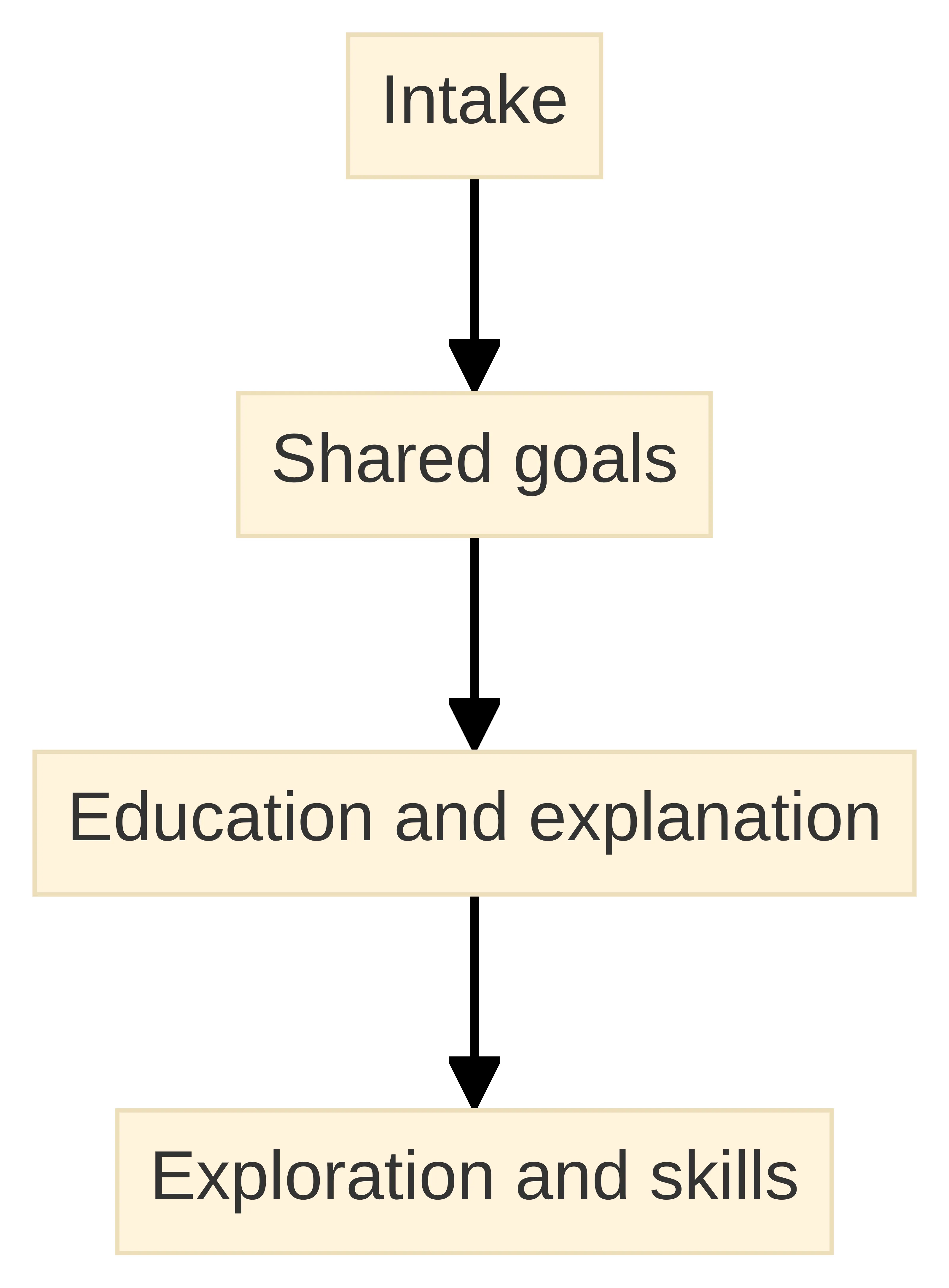
The first visit at The Emerald Couch includes a thorough intake session to gather information and assess your needs.
Shared goals are another part of the stated process. We co-create goals with you and identify what success looks like for you. You do not need to arrive with a polished plan; a useful starting point can be a change you want to explore, a pattern you want to understand, or a situation you want to handle differently.
Education and treatment planning may also be part of the work. We provide education, explain our understanding of your situation, and customize scientifically-backed treatments. Ask what that explanation would look like for your concerns and how your questions would shape the conversation.
Our therapy includes learning new coping mechanisms and skills to manage stress, anxiety, or other challenges. Skills are not a promise that symptoms will change in a particular way. They are one possible part of a process you can discuss in relation to your goals and daily life.
Our therapy involves exploring your thoughts, feelings, and behaviors and may include reflecting on emotional or physical responses. This can give you a concrete question to ask: how would sessions balance understanding your patterns with deciding what you want to practice or address? Use the answer to judge whether the proposed process feels clear enough to continue exploring.
You can summarize the process check this way:
- The intake gives you a chance to describe your needs.
- Shared goals give the work a direction.
- Education and explanation help you understand the proposed approach.
- Exploration and skills may connect the conversation to everyday challenges.
Treat these as questions about how care is organized, not as a forecast of your personal outcome.
Choose the format you can realistically use
The Emerald Couch offers both face-to-face counseling and telehealth therapy. The practical choice is the format that fits your preferences, schedule, privacy, and ability to attend consistently. The available information does not establish that either format is clinically better for anxiety, so compare access rather than looking for a universal winner.
| Fit question | Face-to-face counseling | Telehealth therapy |
|---|---|---|
| Setting | Consider whether attending an office works with your routine. | Consider whether a remote session works with your routine and available privacy. |
| Travel | Include the time and effort required to reach the office. | Reduce the need to travel for the session itself. |
| Personal preference | Choose this direction if meeting in person feels more comfortable or natural to you. | Choose this direction if participating remotely feels more workable to you. |
| Scheduling | Ask what in-person appointment times are currently available. | Ask what telehealth appointment times are currently available. |
| Decision boundary | Use it when the in-person setting fits your practical needs. | Use it when the remote setting fits your practical needs. |
Your choice does not need to be based on a theory about anxiety treatment. Ask which format is available for the appointment you want, whether the setting meets your privacy needs, and whether you can make the schedule work. If you prefer one format but could use the other, mention that during the consultation rather than treating the preference as an all-or-nothing decision.
Write down your preferred format and your backup format before you reach out. Then ask whether either option is available for your situation. That gives you a clear access question without assuming that format alone determines clinical fit. Use a two-part format decision: first, identify the option you prefer; second, identify the condition that would make the other option workable. For example, your preference may be face-to-face counseling because an office setting feels more natural, while telehealth may remain a backup if travel or scheduling makes the office difficult. Then verify which option is currently available, whether you have the privacy needed, and whether the appointment time can be maintained. This turns a preference into a practical booking question without claiming that one format is better for anxiety.
Verify insurance and self-pay details before booking
The Emerald Couch is in-network with Aetna and Lyra. Your specific plan and benefits still matter, so ask your insurer what your plan covers and what amount you would owe for the service you are considering.
Our out-of-network rate for therapy is $220 a session. If you are considering out-of-network care, ask how payment would work for your appointment and what your plan may do with an out-of-network claim.
Keep the financial questions separate:
- Practice information: Are you currently accepting my insurance plan, and which appointment formats are available?
- Plan information: What does my specific Aetna, Lyra, or other plan cover for this service, and what would I pay?
- Self-pay information: Would the $220 out-of-network rate apply to the appointment I am considering?
- Timing information: What payment or coverage questions need an answer before the first visit?
This separation prevents a network label from being mistaken for a personal coverage decision.
Do not choose solely because a practice appears in-network, and do not reject the option solely because you have not yet estimated your plan’s cost. Get the coverage information that applies to you, then compare it with the stated rate and the format you want. Insurance details can change, so use current information when you are ready to arrange care. A useful record for this check has three lines: the network information supplied by The Emerald Couch, the coverage and amount you need to confirm with your insurer, and the stated out-of-network rate if that route is relevant. Keep those lines separate when you compare options. The Emerald Couch can provide its current participation and rate information; ask your insurer about your plan’s coverage and what you would owe. Recheck these details when you are ready to book rather than relying on an old answer.
Use the consultation to test fit and clarify logistics
The Emerald Couch offers a free 30-minute consultation for discussing your needs. Verify whether the consultation is conducted by video before booking. Use that conversation to explain why you are looking for anxiety therapy, describe the concerns you want to address, and ask the questions that remain after your initial fit check.
Look for a therapist who is skilled in the areas you hope to approach. You can make that question specific by asking how the therapist works with anxiety, trauma, OCD, phobias, or another concern that is relevant to you. A direct answer can help you decide whether the stated focus matches the conversation you want to have.
Ask about educational background, training, and specialized certifications related to your concerns, such as trauma or anxiety treatment. You are not asking for a credential list as a substitute for fit. You are asking whether the therapist’s preparation is relevant to the areas you hope to approach.
Identify whether the therapist resonates with your needs and preferences. That can include communication style, comfort discussing sensitive experiences, attention to your identity and background, and the balance between practical skills and reflection. You can say what helps you feel understood and ask how those preferences could be included in therapy.
Discuss policies regarding appointment frequency and duration. Add questions about face-to-face counseling or telehealth, current appointment availability, and what the first visit involves. A short list is easier to use than trying to remember every concern in the moment:
- What would the first appointment cover?
- How would we set or revisit goals?
- What schedule and session length would be available?
- Which format could I use?
- What should I know about the stated insurance or self-pay information?
Leave the consultation with a clear sense of which questions were answered and which still need attention. After the consultation, sort what you heard into three categories: answered, needs verification, and does not fit. Put concern focus, care approach, format, and questions about goals in answered only when the conversation addressed them clearly. Put availability, current network participation, plan coverage, rate applicability, and session logistics in needs verification when they remain open. Put a preference or boundary in does not fit when the option cannot meet it. This gives you a decision trail without turning the conversation into a promise about treatment results. If important questions remain unanswered, use the stated booking path only after deciding whether to resolve them first.
Confirm what remains unverified
Your decision still depends on details that can change, including appointment availability, the format available for your preferred schedule, your plan’s exact coverage, and the current arrangements for the consultation. The stated Aetna and Lyra network participation, the $220 out-of-network rate, and the free 30-minute consultation give you a starting point; they do not answer every personal access question.
Before you make a final decision, ask:
- Is there an opening for the format and schedule I need?
- Is the free 30-minute consultation available at a time I can use?
- Does my specific insurance plan apply coverage to the service, and what would I owe?
- If I use out-of-network care, would the stated $220 session rate apply to my appointment?
- Are there scheduling details, appointment frequency expectations, or session-duration policies I should understand?
These are current-access questions, not questions you can settle from a general service description.
Keep the decision focused on fit. The Emerald Couch describes therapy as flexible and individualized, offers face-to-face counseling and telehealth therapy, and lists anxiety-related concerns within its stated services. If the format, cost, availability, or focus does not fit your needs, pause and identify which condition is missing rather than forcing the option to work.
Your next action is to resolve only the questions that could change your decision: whether the concern is within the stated focus, whether the care approach feels appropriate, whether you can use the available format, and whether the current cost and coverage work for you. A compact final review can be written as four statements: My concern matches—or needs clarification about—the stated focus. The described individualized, trauma-informed approach fits—or does not fit—what I am seeking. I can use the available face-to-face or telehealth format. I have checked the current financial and scheduling questions that matter to me. If one statement is unresolved, make that the subject of the consultation or verification call. If all four align and the option still feels appropriate, the booking link is the next practical step; if they do not, pause rather than treating the service description as a personal recommendation.
Take the next step when the fit checks align
An adult anxiety-therapy option in Denver is worth pursuing when the stated concerns overlap with what you want to address, the individualized and trauma-informed approach fits your preferences, the format works in your daily life, and the current access details are workable. Bring a short description of your concerns, your preferred format, and your insurance or self-pay questions to the free 30-minute consultation.
You can prepare without making a diagnosis or promising yourself a particular result. Write down what you want help with, what you want to ask about the care process, and which financial or scheduling detail could change your decision. If those checks align after your questions are answered, use the available booking option to begin the conversation.
Questions to resolve before choosing anxiety therapy
What types of anxiety-related concerns does The Emerald Couch treat?
The Emerald Couch specializes in treating trauma, anxiety, including OCD and phobias, and depression.
How does The Emerald Couch approach therapy for anxiety?
The therapy process at The Emerald Couch is flexible and individualized, focusing on trauma-informed care that recognizes trauma symptoms and their root causes.
What formats of therapy are available at The Emerald Couch?
The Emerald Couch offers both face-to-face counseling and telehealth therapy to accommodate client preferences.
What is the cost of therapy at The Emerald Couch?
The stated out-of-network rate is $220 per session, and The Emerald Couch is in-network with Aetna and Lyra.
How can I verify my insurance coverage for therapy at The Emerald Couch?
It's important to ask your insurer about your specific plan's coverage and what amount you would owe for the services you are considering.
Sources
- Trauma-Informed Therapy — www.ncbi.nlm.nih.gov
- Contact — The Emerald Couch — www.theemeraldcouch.com
- Key Questions for Your Consultation with a Therapist, Counselor, or Psychologist — The Emerald Couch
- What to expect from counseling, mental health, psychotherapy, and therapy in Denver — The Emerald Couch
- The Emerald Couch
- The Top Myths About Counseling in Denver — The Emerald Couch
- How This Works — The Emerald Couch
- Finding the right therapist for your needs — The Emerald Couch