

Begin with what is—and is not—confirmed
Starting therapy with insurance involves two separate questions: whether The Emerald Couch has an in-network relationship with your insurer, and what your specific plan will cover for you. As of October 28, 2026, we are in-network with Aetna and Lyra. That relationship does not, by itself, establish your eligibility, benefits, authorization requirements, or cost sharing.
Use a verification-first path before you decide whether to schedule:
- Identify the exact plan or Lyra benefit available to you. Your insurer, employer, or Lyra account can provide details that a general network label cannot.
The main boundary is simple: an in-network relationship is a starting point, not a promise about what you will owe. Your plan may apply its own rules to eligibility, benefits, authorization, and cost sharing. Keep those plan-specific answers separate from the information we provide about our services.
Treat network status as the first checkpoint, not the answer
The Emerald Couch is in-network with Aetna and Lyra. This tells you that we have stated network relationships with those organizations, but it does not tell you whether your particular plan is active, whether outpatient therapy is included, or what part of the cost will apply to you.
Network participation and personal coverage are different checkpoints. Your plan may have its own eligibility rules, benefit limits, authorization requirements, deductible status, copayment, coinsurance, or other cost-sharing terms. Our published guidance says we accept Lyra and that some providers also accept Aetna; for other plans, it advises asking whether you would pay upfront and what documentation may be available for reimbursement. That guidance does not establish reimbursement for your plan.
Before treating the network label as an answer, write down these details:
- The insurer or Lyra program name and the exact plan name.
- The member identification number and the customer-service number on your card or account.
- Whether your coverage is active on the date you expect to begin therapy.
- Whether the therapist or service location you are considering is handled under your plan's behavioral-health benefit.
- Whether your plan requires a referral, prior authorization, or another approval step.
- Whether payment is expected at the session and whether any claim documentation may be available.
Call the insurer or use your Lyra benefit with those details in front of you. Then bring the answers into your conversation with The Emerald Couch. If the plan representative gives you a reference number, save it with the date and the name or department that handled your question.
Understand the Aetna questions that can change your estimate
Aetna's behavioral-health precertification guide, effective August 1, 2024, explains that precertification is also called prior authorization or prior approval. The guide provides CPT-code guidance for services that may require approval under applicable Aetna plans. It does not mean that every Aetna plan uses the same rule for every therapy service.
Ask Aetna which rule applies to your plan and the therapy service you are considering. Aetna also says its Clinical Policy Bulletins help administer plan benefits but are not a description of your specific plan's benefits. Use your plan materials or Aetna's member-support channel for the coverage answer that applies to you.
Your Aetna question list can include:
- Is my plan active, and does it include outpatient behavioral-health therapy?
- Is The Emerald Couch or the therapist I am considering treated as in-network under my exact plan?
- Does my plan require a referral, precertification, prior authorization, or prior approval before the first session?
- If approval is required, who submits it, which service or CPT code is involved, and how long should I allow for that step?
- What copayment, deductible, coinsurance, or other cost-sharing term applies to each session?
- How much of my deductible has already been met, and does the remaining amount affect therapy costs?
- Is there a visit limit, authorization period, or renewal step that could affect ongoing appointments?
Do not build your estimate from a general Aetna explanation alone. Aetna's own statement separates benefit-administration materials from the description of an individual plan, while The Emerald Couch's guidance recommends reviewing your copayment and deductible status before starting. Ask for the answer in terms of your plan, the service, and the timing of payment.
One useful distinction is between authorization and cost. An answer about whether approval is required does not, by itself, answer what deductible, copayment, or coinsurance applies. Conversely, a quoted cost-sharing term does not establish that you are eligible on the date of care or that any required approval has been completed. Record these as separate answers, along with the plan name and date of the response, so a general explanation is not mistaken for a complete estimate.
Understand how Lyra cost sharing and claims may work
Lyra's cost-share terms say Lyra may charge the designated cost share, typically when a claim is submitted or adjudicated by your plan. The timing described in those terms is not the same as a universal promise about when every member pays or how much every member owes. Your current Lyra and employer-plan terms control the arrangement available to you.
Lyra's terms also say that when you see a Lyra provider through a plan, Lyra may submit a claim directly or through a subcontractor. The claim may include information such as your name, diagnosis, and services received. If claim handling matters to your decision, ask Lyra how the benefit is administered for your account and review the current terms that apply to you.
Ask Lyra these questions before you rely on the benefit for therapy:
- Is my Lyra benefit active, and which therapy services and providers are available through it?
- What cost share applies to my sessions, and when is it typically charged?
- Does my employer plan add eligibility, authorization, visit, or scheduling conditions?
- Who submits the claim, and what information will be included?
- Will the benefit apply to the format and appointment arrangement I am considering?
- What happens if I schedule outside the Lyra pathway or if a claim is not submitted through Lyra?
A Lyra network relationship therefore gives you a route to investigate coverage; it does not give you a fixed personal cost before your plan answers the relevant questions. Keep the cost-share timing, claim process, and eligibility answer together when deciding whether the arrangement fits your budget and access needs.
Pay attention to the sequence as well as the amount. Lyra's terms describe a possible charge when a claim is submitted or adjudicated, so the date of an appointment and the timing of a cost-share charge may not be identical. If that timing matters to your planning, ask which event triggers the charge for your benefit and whether using the intended appointment pathway changes how the claim is handled. Treat that answer as separate from the question of whether the benefit is active.
Use three separate question lists before choosing a session
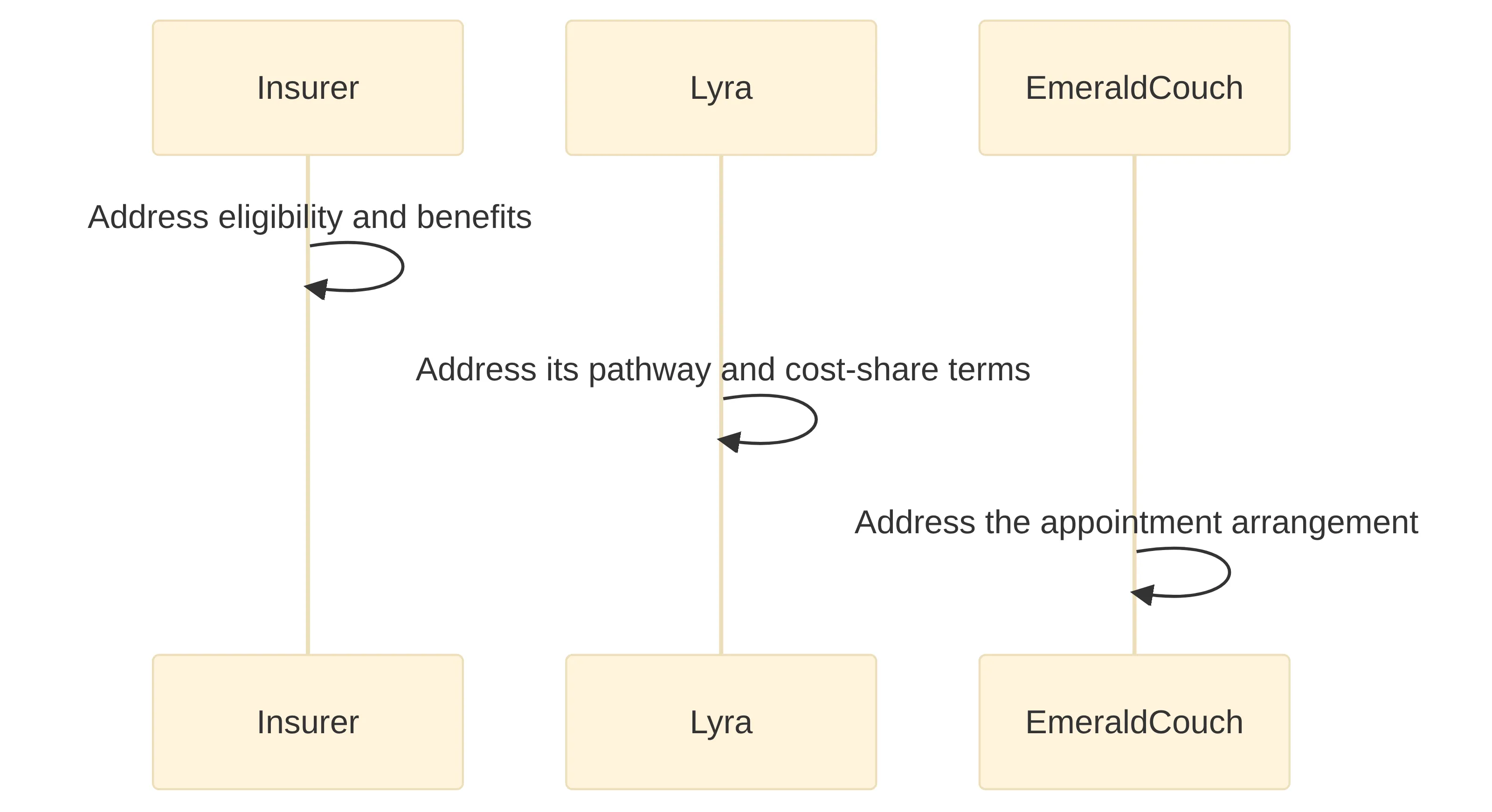
Three conversations may provide three different parts of the answer: your insurer or employer plan can address eligibility and benefits, Lyra can address its pathway and cost-share terms, and The Emerald Couch can address the appointment arrangement. Keeping the lists separate helps you avoid treating one organization’s answer as another organization’s promise.
Ask your insurer or plan administrator:
- Is my coverage active for the date I want to begin?
- Does my exact plan include outpatient therapy with an in-network behavioral-health provider?
- Is The Emerald Couch or the therapist I am considering in-network under my plan, rather than only under the insurer’s broader network?
- What copayment, deductible, coinsurance, or other cost-sharing term applies?
- Do I need a referral, precertification, prior authorization, or prior approval?
- What information should appear on a claim, and what should I keep for my records?
Ask Lyra or the Lyra contact connected with your plan:
- Is my Lyra benefit active, and can I use it with the therapist or appointment format I am considering?
- What designated cost share applies to me, and when may it be charged?
- Does Lyra submit the claim, or does another organization submit it?
- What information may accompany the claim?
- Are there employer-plan limits, approval steps, or appointment conditions that I need to address first?
- What changes if I do not use the Lyra pathway for the appointment?
Ask The Emerald Couch:
- Which appointment formats and times are available for the therapist I am considering?
- How would payment and claim handling work with my Aetna or Lyra arrangement?
- What should I expect financially if my plan applies a deductible, cost share, or payment-at-visit requirement?
- Is the therapist experienced in the concerns I want to address?
- What are the policies for appointment frequency and session duration?
- What should I know about the first visit and the information gathered during intake?
Use a simple record for each conversation: the date, organization, department or representative, answer, and any reference number. Mark each answer as applying to your plan, the Lyra pathway, or The Emerald Couch. That distinction gives you a usable decision record instead of one blended estimate.
If answers do not line up, route the follow-up to the organization responsible for that part of the arrangement rather than choosing the most favorable interpretation. Ask the insurer or plan administrator to clarify individual benefits and cost sharing, Lyra to clarify its pathway and terms, and The Emerald Couch to clarify appointment availability and its payment or claim process. Keep the unresolved question visible until the responsible source addresses it.
Set a cost boundary before booking
Our out-of-network therapy rate is $220 per session. That is our stated rate for an out-of-network session; it does not establish what an insurer will reimburse or what your particular plan will require you to pay. If your Aetna or Lyra arrangement does not handle the appointment as expected, the payment path may differ from an in-network estimate.
Before you schedule, write down the five numbers or conditions that matter to your boundary:
- The amount your plan says may apply to each session.
- The portion of your deductible that remains, if your plan applies one.
- Any authorization or approval condition that must be completed first.
- The amount or timing that may be charged through Lyra, if you are using Lyra.
- The $220 out-of-network rate that applies to our stated out-of-network therapy arrangement.
After listing these items, mark each one as confirmed, pending, or unresolved. Use “confirmed” only when the answer is tied to your exact plan or Lyra benefit and to the appointment arrangement you are considering. Use “pending” when a responsible organization has identified a next step, such as authorization or claim handling, but that step is not complete. Use “unresolved” when the answer is general, conflicts with another response, or leaves payment responsibility unclear.
This creates a decision record rather than a predicted bill. It shows which questions still belong with Aetna, Lyra, or The Emerald Couch and prevents a general network statement from being counted as a personal cost answer. Do not mark an item confirmed merely because it sounds favorable; record the date and source of the answer so you can distinguish a current, plan-specific response from general information. Before booking, review the unresolved items and decide whether they affect your budget, the appointment format, or the route through which the claim will be handled. If they do, keep that item open and direct the follow-up to the organization responsible for it.
Then set a clear personal rule. For example, you might decide that you will schedule only after you know whether payment is expected at the appointment, what cost-sharing term applies, and whether any approval step is complete. If one of those answers remains unclear, pause the financial decision and ask the organization responsible for that answer rather than filling the gap with an assumption.
Do not compare the $220 figure directly with a copayment until you know what each figure represents. The $220 amount is The Emerald Couch's stated rate for an out-of-network session, while a plan's copayment, deductible, or coinsurance describes a plan-specific cost-sharing arrangement. Those figures may describe different payment paths and should not be treated as interchangeable. Label each amount by its source and arrangement before using it in your personal cost boundary.
Our stated rate and network relationships describe The Emerald Couch. They do not replace your plan’s explanation of benefits or establish reimbursement. Use the plan-specific answer for your budget, and use our information to understand the appointment arrangement you are considering.
Choose online or in-person care for access reasons
We offer both face-to-face counseling and telehealth therapy. Choose between them as an access decision: consider whether you can get to the Denver office, whether a remote appointment fits your available setting, and which format you can attend consistently. Current availability for each format is a separate appointment question.
Ask these format questions before you settle on an appointment:
- Is the therapist I am considering offering face-to-face sessions, telehealth sessions, or both?
- Where would an in-person appointment take place, and what appointment times are available?
- What do I need for a remote appointment, including a private setting and the required technology?
- Does my Aetna or Lyra arrangement apply to the format I want?
- Would the claim pathway or cost-share timing change between formats?
- How should I handle a future appointment if my preferred format is unavailable?
The format choice does not settle network status, benefits, authorization, or cost. Ask the coverage question separately from the access question, then choose the format that fits the answers you receive and the appointments available to you.
If your preferred format is available but its coverage or claim pathway is still unclear, keep the format decision open rather than treating convenience as confirmation of payment. Conversely, a coverage answer is not an appointment answer: you still need to know whether the therapist and time you are considering are available in that format. A complete access check therefore has two parts—whether the arrangement applies and whether you can realistically attend it.
Check fit alongside coverage
Insurance information is only one part of deciding whether to begin. We specialize in treating trauma and anxiety in adults, and we work exclusively with adult clients rather than children. If your concerns fall outside that scope, address that boundary before treating network status as a reason to proceed.
The Emerald Couch’s guidance recommends looking for a therapist skilled in the areas you hope to address. It also recommends asking about appointment frequency and session duration so you can understand whether the arrangement fits your needs. Coverage can make an appointment financially possible, but it cannot answer those fit questions for you.
Bring these questions into the consultation conversation:
- Do you work with the concerns I want to address?
- What experience or training is relevant to those concerns?
- How often are appointments usually scheduled, and how long are sessions?
- How do we decide whether the format and pace fit my needs?
- Can I ask questions about culturally responsive and LGBTQIA+-affirming care so I understand whether the setting feels respectful to me?
- What would happen if I decide the arrangement is not a fit?
The Emerald Couch is committed to providing a safe, inclusive, and non-judgmental environment for LGBTQIA+ individuals and other marginalized populations. Asking how care reflects your identity and concerns can help you evaluate the setting alongside therapist focus, scheduling, format, and coverage; it does not replace any plan-specific verification.
Make two notes after the conversation: one for coverage and cost, and one for fit and access. You do not need to treat a favorable answer in one category as an answer in the other. Proceed only when the arrangement fits the concerns you want to address, the format you can attend, and the financial information you understand.
A practical fit check has two layers. First, ask whether the therapist's skills and focus relate to the concerns you want to address. Second, ask whether the working arrangement—such as appointment frequency, session duration, and format—fits what you can maintain. Keeping those layers distinct helps you evaluate both the subject of therapy and the structure of care without turning insurance status into a substitute for either question.
Use the consultation as a clarification step
We offer a complimentary 30-minute consultation to help you get started. Consultation details and billing should be discussed before booking. The consultation is a chance to organize questions about access, coverage, cost, session format, and fit; it is not a guarantee that your plan will cover later therapy sessions.
Prepare a short briefing before the conversation:
- Your insurer, exact plan, or Lyra benefit.
- The answers you received about eligibility, cost sharing, deductible status, and authorization.
- Any reference number or written explanation connected with those answers.
- Whether you prefer face-to-face counseling or telehealth therapy.
- The concerns you want to address and the questions you have about therapist fit.
- The amount and timing you understand may apply to the appointment.
The consultation and the first therapy visit are not automatically the same event. At your first visit, we conduct a thorough intake to gather information and assess your needs. Ask how the consultation relates to a first visit, what information will be gathered, and which payment or claim arrangement applies to each appointment.
Use the conversation to clarify, not to guess. Leave with a short list of answers: whether the intended appointment path is available, which cost questions remain with Aetna or Lyra, what session format is possible, and whether the therapist’s focus and scheduling policies fit what you need.
Make the booking decision only after verification
You are ready to make a more informed decision when four answers line up: your plan or Lyra benefit is active for the service, the applicable authorization step is understood, the likely cost and payment timing are clear enough for your budget, and the format and therapist fit your needs. The Emerald Couch’s Aetna and Lyra network relationships are useful starting points, while your plan-specific answers determine your coverage and cost.
Bring your question list and coverage notes into the next conversation. Use that conversation to discuss therapy access, coverage questions, cost, format, and fit without treating the appointment as a promise of insurance payment.
Questions to resolve before using Aetna or Lyra coverage
What should I verify about my Aetna or Lyra coverage before booking therapy?
Before booking therapy, verify your specific plan details, including eligibility, cost sharing, deductible status, and any authorization requirements.
How does The Emerald Couch's in-network status with Aetna and Lyra affect my therapy costs?
The Emerald Couch is in-network with Aetna and Lyra, but this does not guarantee coverage for your specific plan. You should confirm your plan's benefits and any potential out-of-pocket costs before scheduling.
What is the out-of-network rate for therapy at The Emerald Couch?
The out-of-network rate for therapy at The Emerald Couch is $220 per session. This rate does not determine what your insurance may reimburse.
What questions should I ask my insurer regarding therapy coverage?
When contacting your insurer, ask about your plan's active status, whether it includes outpatient therapy, any required referrals or authorizations, and the specific cost-sharing terms that apply to therapy sessions.
What should I consider when choosing between in-person and telehealth therapy sessions?
Consider your ability to attend in-person sessions at The Emerald Couch's Denver location versus the convenience of telehealth. Evaluate which format fits your schedule and comfort level.
What is the purpose of the complimentary consultation offered by The Emerald Couch?
The complimentary consultation is an opportunity to discuss your therapy needs, clarify coverage and cost questions, and determine if the therapist's approach aligns with your goals.
How can I ensure that my therapist is a good fit for my needs?
During your consultation, ask about the therapist's experience with your specific concerns, their approach to therapy, and how often sessions are typically scheduled to ensure they align with your needs.
Sources
- How to Deal with Irrational Anxiety: A Step-by-Step Guide — blog.theemeraldcouch.com, 2026-08-05
- How Much Is a Therapy Session with Insurance? Understand Costs — blog.theemeraldcouch.com, 2026-04-29
- Participating provider behavioral health precertification list ... — www.aetna.com
- Premiums, Deductibles, Coinsurance & Copays Explained | Aetna — www.aetna.com
- Cost Share Terms and Conditions (Copay / Coinsurance) — www.lyrahealth.com
- Finding the right therapist for your needs — The Emerald Couch
- Key Questions for Your Consultation with a Therapist, Counselor, or Psychologist — The Emerald Couch