

How to approach the decision without choosing by label alone
A decision about trauma-focused support in Denver starts with more than a treatment name. You need to understand what the approach asks you to do, whether the therapist explains the reasoning clearly, how the pace may work, and whether the plan can respond to your needs.
The VA/DoD clinical practice guideline strongly recommends individual, manualized trauma-focused psychotherapy for primary PTSD treatment. That recommendation gives you a meaningful clinical starting point, but it does not identify one universal protocol for every person or every trauma-related concern. A review reports that trauma treatments may be past-focused, present-focused, or a combination of the two, and that neither broad type consistently outperforms the other in randomized-trial outcomes.
Treatment labels also conceal meaningful differences. A meta-analysis notes that some therapies classified as trauma-focused did not directly focus on the trauma memory. Ask what a therapist means by a label, what sessions involve, and how the approach connects with your goals before you decide whether the fit makes sense.
What trauma and PTSD therapy may address
Trauma-focused therapy may address the memories, emotions, beliefs, body sensations, and current difficulties connected with a traumatic experience. Past-focused models may ask you to explore the trauma and its meaning in detail. Present-focused models may emphasize education and coping skills for current functioning, including interpersonal, cognitive, or behavioral difficulties.
The VA describes trauma-focused talk therapy as helping you work through trauma and what it means to you. The same VA information describes Cognitive Processing Therapy, or CPT, as teaching you to reframe negative thoughts about the trauma. These descriptions explain the general direction of treatment; they do not tell you exactly how a particular therapist structures each session.
PTSD treatment can therefore include work with the past, work with the present, or a combination. Your first task is not to prove that you can tolerate a particular method. Your first task is to learn what the therapist proposes, why the therapist proposes it, and how you can discuss the pace if the work feels difficult.
Trauma-informed care adds context to the treatment plan. SAMHSA guidance describes transparent trauma-related intake questions, education about trauma and stress reactions, and explanations of treatment methods and the rationale for specific interventions. The VA/DoD provider summary describes assessment as considering presenting concerns, co-occurring conditions, trauma history and exposure duration, prior treatment, and psychosocial context.
That context matters because trauma does not appear in isolation from the rest of your life. A useful conversation can include what you want to change, what has already been tried, what affects your day-to-day functioning, and what questions you have about the proposed work.
Compare treatment by focus before comparing names
Past-focused and present-focused treatment offer a practical first comparison because the distinction describes the kind of work sessions may emphasize.
| Treatment focus | What it may ask you to examine | What it may emphasize |
|---|---|---|
| Past-focused | Trauma-related memories, emotions, beliefs, or body sensations | Processing painful experiences and their meanings |
| Present-focused | Current difficulties and functioning | Psychoeducation and coping skills |
| Combined | Past experiences and present-day effects | A plan that connects processing with current support |
The review identifies Prolonged Exposure, Cognitive Processing Therapy, and EMDR as examples of past-focused PTSD treatment models. The same review describes present-focused models that emphasize education and coping. Use this distinction to ask a concrete question: “What will we spend time doing in sessions, and how will that work relate to what I want to address?”
The comparison is a guide, not a ranking. The review reports that both past-focused and present-focused treatment types work and that neither consistently outperforms the other on randomized-trial outcomes. The meta-analysis also notes that treatment categories can contain meaningful internal differences, so two therapists may use the same label in different ways.
Compare the approach on shared criteria:
- Focus: Does the plan address memories, current coping, or both?
- Explanation: Can the therapist describe the purpose of each part of treatment in plain language?
- Participation: Do you understand what you would be asked to discuss, practice, or notice?
- Pace: Can you ask how the therapist would respond if the work feels too fast or does not match your goals?
These questions help you compare the actual treatment relationship rather than choosing from a list of names.
What CPT, Prolonged Exposure, EMDR, and somatic approaches tell you
Treatment names such as CPT and Prolonged Exposure become more useful when you connect them to the work they describe.
- Cognitive Processing Therapy: The Emerald Couch describes CPT as including education about PTSD and CPT, processing trauma through a written trauma narrative, challenging trauma-related thoughts, and addressing areas of life affected by trauma. The practice also describes its CPT approach as helping you examine and change unhelpful thoughts and feelings related to traumatic events, yourself, other people, and the world.
- Prolonged Exposure: The Emerald Couch provides Prolonged Exposure therapy that teaches you to gradually approach trauma-related memories, feelings, and situations you have been avoiding. Ask how the therapist explains the steps, how progress is discussed, and how the pace is addressed in your plan.
- EMDR: A selected clinical review lists EMDR among past-focused PTSD treatment models. The Emerald Couch states that Rachel Kirkman has experience using CPT and EMDR to treat traumatic experiences. Ask an EMDR therapist to describe what sessions involve, what participation looks like, and how the approach relates to your goals.
- Somatic approaches: If a therapist offers a somatic approach, ask what that term means in that therapist’s work. Ask which sensations, exercises, conversations, or forms of observation may be part of sessions, how the work connects with your goals, and how you can discuss the pace. The label by itself does not answer those practical questions.
Treatment approaches can differ in how directly they discuss the traumatic experience, how much they emphasize current coping, and how they explain the reason for each intervention. Trauma-informed guidance supports explaining treatment methods and their rationale rather than asking you to accept a label without context.
A therapist does not need to present every option as interchangeable. You do need enough information to understand the proposed approach and ask questions about alternatives, participation, and pacing. If you are comparing CPT, Prolonged Exposure, EMDR, or a somatic approach, write down the specific answer you receive for each of those points. That gives you something more useful than a promise attached to a treatment name.
Look for transparency, choice, and an adaptable plan
Trauma-informed care places transparency beside the treatment method. SAMHSA guidance describes explaining the value and types of trauma-related intake questions, educating you about trauma responses, and explaining the rationale for specific interventions. Those practices give you language for asking what will happen and why.
An adaptable plan should also leave room to discuss your goals as therapy develops. The Emerald Couch describes therapy as flexible and individualized to respond to your needs. The practice also states that clients may adjust short- and long-term goals as therapy evolves. In practical terms, ask how goals are set, how often they are revisited, and what you can do if the plan no longer matches what you want to address.
Trust is not created by a treatment label. The Emerald Couch recognizes that building trust while addressing PTSD or trauma can be challenging and states that comfort is prioritized in therapy. You can use that premise as a fit question: “How will we talk about comfort, pace, and concerns if I am unsure about part of the process?”
The Emerald Couch specializes in treating trauma and anxiety in adults. Denver adults considering care can therefore ask direct questions about the treatment approach, the therapist’s skill in the areas they want to address, and the structure of the first visits. A clear answer is useful information; you do not have to decide on ongoing therapy before you understand the plan.
What assessment and early sessions may involve
An early therapy process commonly begins with information gathering and a discussion of what brings you to care. The VA/DoD provider summary describes a comprehensive assessment that considers presenting concerns, co-occurring conditions, trauma history, duration of exposure, prior medication or psychosocial treatment, and psychosocial factors. It also includes safety, lethal-means, and environmental assessment among general assessment considerations.
Trauma-informed assessment is not only a list of questions. SAMHSA guidance describes explaining the value and types of trauma-related questions and educating you about trauma responses. You can ask why a question matters, how the information will shape the plan, and what topics may be addressed during the first visit.
The Emerald Couch states that its first visit includes a thorough intake session to gather information and assess your needs. The practice describes therapy as involving exploration of thoughts, feelings, and behaviors, with reflection on emotional or physical responses. It also describes learning coping mechanisms and skills to manage stress, anxiety, or other challenges.
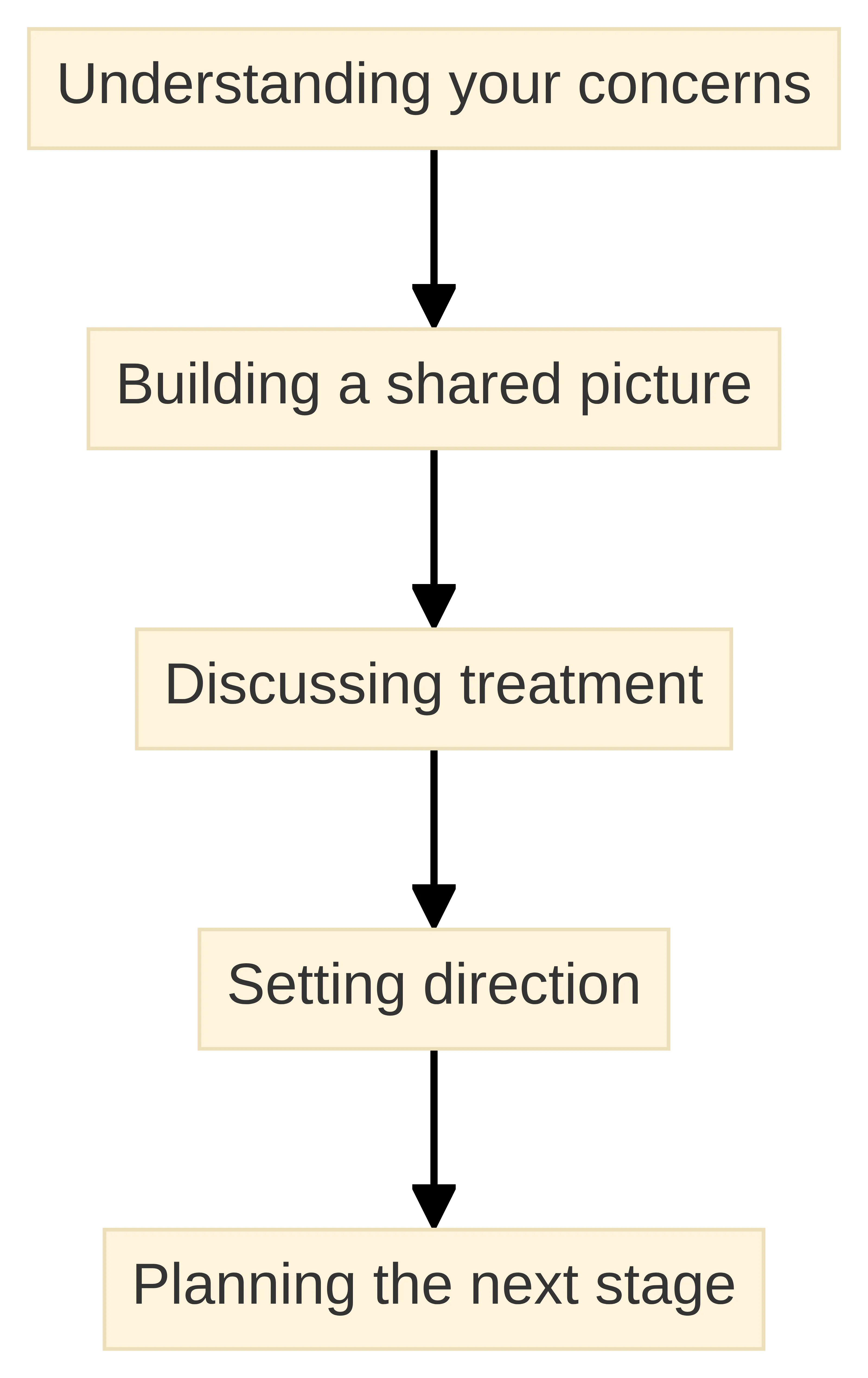
A first visit may therefore include several connected tasks:
- Understanding your concerns: You describe what has been happening and what you want help addressing.
- Building a shared picture: You and the therapist discuss relevant history, current effects, and factors that may shape care.
- Discussing treatment: The therapist explains the proposed method and why it may fit the concerns under discussion.
- Setting direction: You identify goals and what progress would mean for you.
- Planning the next stage: You ask about pace, appointment frequency, duration, and how goals can change.
The process is not a test that you must pass by telling the entire story immediately. Ask what information is needed now, what can wait, and how the therapist will help you understand the next step.
Questions to use in a trauma-therapy consultation
A trauma-therapy consultation can help you evaluate the therapist’s skills, explanation, pace, and practical structure before you choose ongoing care. The Emerald Couch recommends looking for a therapist skilled in the areas you hope to address.
Bring questions such as:
- What treatment focus do you recommend for my concerns: past-focused, present-focused, or a combination?
- What would sessions ask me to do or discuss?
- How would CPT, Prolonged Exposure, EMDR, or a somatic approach differ in your work?
- What is the reason for the method you are recommending?
- How would we discuss the pace if a topic or exercise feels too difficult?
- How would you and I define goals, and how could those goals change as therapy develops?
- What appointment frequency and duration do you typically discuss when beginning care?
- How do you explain trauma-related intake questions and the information they provide?
- How do you decide whether to focus on trauma memories, current coping, or both?
A therapist’s answer does not need to predict your entire course of care. It should give you enough detail to understand the proposed work and decide what you still need to ask.
A short written list can make the conversation easier to follow. Mark the answers that clarify the treatment focus, explain the rationale, address pacing, and describe the practical schedule. Notice which questions remain unanswered, then ask a follow-up rather than filling the gap with an assumption.
The point of these questions is not to force a particular treatment choice. The point is to help you compare the therapist’s actual plan with the kind of support you are seeking.
How clinical recommendations and personal preference fit together
Clinical recommendations and personal preference answer different parts of a treatment decision. For primary PTSD treatment, the VA/DoD guideline strongly recommends individual, manualized trauma-focused psychotherapy over other pharmacologic and non-pharmacologic interventions. That recommendation speaks to the clinical direction of care for primary PTSD; it does not decide which therapist, protocol, pace, or format fits your circumstances.
The review reports that past-focused and present-focused PTSD treatment types both work and that neither consistently outperforms the other on randomized-trial outcomes. That finding supports a careful comparison rather than a search for a universal winner. Ask how the proposed approach relates to your concerns and what the therapist would do if the approach is not preferred or is not workable for you.
When individual trauma-focused psychotherapy is not readily available or not preferred, the VA/DoD guideline says pharmacotherapy or individual non-trauma-focused psychotherapy may be considered without favoring one of those alternatives. The boundary is specific: the guideline’s primary recommendation and its alternatives address PTSD treatment decisions, not every form of distress after a traumatic experience.
You can hold both ideas at once: clinical guidance matters, and your questions about participation, pace, explanation, and fit matter too. Use the recommendation to ask informed questions, not to treat a treatment label as a guarantee.
A comfortable next step for exploring care in Denver
A decision to explore therapy in Denver can begin with information rather than a commitment to a particular label. Compare the treatment focus, ask why the therapist recommends it, discuss the pace, and decide whether the proposed process gives you enough clarity to continue asking questions.
The Emerald Couch specializes in treating trauma and anxiety in adults, works exclusively with adult clients, and describes its therapy as flexible and individualized. Bring the questions above to the next conversation and take the time you need to understand the plan.
Questions adults often ask before starting trauma therapy
What types of therapy are available for trauma and PTSD in Denver?
In Denver, therapy for trauma and PTSD may include past-focused approaches like Cognitive Processing Therapy (CPT) and Prolonged Exposure, as well as present-focused methods that emphasize coping skills and psychoeducation. Some therapists may also offer a combination of these approaches.
How can I evaluate a trauma-informed therapist before starting therapy?
When evaluating a trauma-informed therapist, consider asking about their treatment focus, what sessions will involve, how they explain their methods, and how they handle pacing if the work feels overwhelming. It's also important to discuss appointment frequency and duration.
What should I expect during my first therapy session for trauma or PTSD?
During your first therapy session, you can expect a thorough intake process where the therapist gathers information about your concerns, discusses your history, and explains the proposed treatment approach. This session is also an opportunity to set goals and discuss how therapy will proceed.
How does The Emerald Couch approach therapy for trauma and PTSD?
The Emerald Couch specializes in treating trauma and anxiety in adults, offering flexible and individualized therapy that may include evidence-based approaches like CPT and EMDR.
What questions should I ask a therapist during a consultation for trauma therapy?
You might ask about their recommended treatment focus, what sessions will involve, how they define success in therapy, and how they handle adjustments to goals as therapy progresses. It's also helpful to inquire about their experience with specific trauma-focused therapies.
What are the costs associated with therapy at The Emerald Couch?
The Emerald Couch charges $220 for out-of-network sessions and accepts Aetna and Lyra insurance plans. They also offer a free 30-minute consultation to discuss therapy options.
Sources
- VA/DoD Clinical Practice Guideline for Management of ... — www.healthquality.va.gov
- Trauma-Informed Care in Behavioral Health Services — library.samhsa.gov
- The problem of dropout from “gold standard” PTSD therapies — pmc.ncbi.nlm.nih.gov
- Management of Posttraumatic Stress Disorder and Acute ... — www.healthquality.va.gov
- VA.gov | Veterans Affairs — www.ptsd.va.gov
- What to expect from counseling, mental health, psychotherapy, and therapy in Denver — The Emerald Couch
- Groups — The Emerald Couch
- The Emerald Couch
- Services — The Emerald Couch
- The Top Myths About Counseling in Denver — The Emerald Couch
- About — The Emerald Couch
- How This Works — The Emerald Couch
- Key Questions for Your Consultation with a Therapist, Counselor, or Psychologist — The Emerald Couch