

Start with the question ERP is meant to answer
ERP may be a sensible treatment to discuss when religious or moral fears become tied to obsessive doubt, avoidance, or repeated attempts to obtain certainty. The question is not whether your faith is correct, whether a religious obligation applies, or whether you should change your beliefs. The practical question is whether a qualified therapist can help you respond differently to an OCD cycle while your values remain yours.
This article offers general education for adults in Denver who are researching scrupulosity and exposure and response prevention. It cannot determine whether you have OCD, identify your compulsions, or prescribe an exposure for you. A qualified therapist would need to understand your concerns, history, values, and current circumstances before discussing individual care.
ERP can sound unsettling when your fears involve sin, blasphemy, morality, punishment, or the possibility of displeasing God. A faith-respecting approach does not treat religious commitment as the problem. It examines whether fear and compulsive certainty-seeking are taking over choices that you would otherwise make from your beliefs and values.
The central ERP question is whether you can approach uncertainty without performing the compulsion that promises relief. Scrupulosity treatment is described as aiming to separate OCD from religious and moral values so you can live consistently with those values. ERP pairs exposure, or facing a trigger, with response prevention, or not performing the compulsion afterward.
You do not have to settle the question by analyzing every thought before seeking information. You can begin by noticing the pattern you want to understand and bringing specific questions to a therapist who can discuss whether ERP fits your circumstances.
Religious commitment and scrupulosity are not the same thing
Scrupulosity is a subtype of OCD involving religious or moral obsessions. The concern may center on whether a thought, action, omission, or feeling means that you have sinned or violated a religious or moral rule. It can also involve fear about what an intrusive thought says about your character.
Religious commitment is not the same thing as scrupulosity. Prayer, study, confession, moral reflection, and participation in religious life can carry meaning within your tradition. The distinction to explore with a qualified therapist is whether fear, doubt, and repetitive responses are becoming difficult to control or are pulling you away from the life your beliefs call you to live.
Scrupulosity can involve fears about blasphemous thoughts, unknowingly committing immoral actions, being condemned, or performing religious obligations incorrectly. The content varies across traditions and across people. The presence of a religious thought or concern does not establish a diagnosis.
You might notice that the concern is less about a chosen act of worship or moral decision and more about an urgent demand to remove every possibility of doubt. That pattern deserves careful discussion rather than a quick conclusion about your faith. Describe the concern in your own language, including the belief or value involved and the response that follows.
The same topic can matter deeply to your faith and still become entangled with an OCD pattern. You do not need to choose between respecting your beliefs and examining the distressing cycle around them.
Notice the cycle of doubt and compulsion
The scrupulosity cycle often begins with an intrusive fear or question and continues with an attempt to make the uncertainty disappear. Scrupulosity-related compulsions can include excessive prayer, obsessive study of religious doctrine, avoidance of religious obligations or objects, and rumination about moral principles. Moral-scrupulosity guidance also describes reassurance-seeking, apologizing, analysis, research, thought suppression, and acts intended to compensate for a feared wrong as possible certainty-seeking responses.
The same outward action can have different meanings in different contexts. Prayer may be a chosen expression of faith, or it may become a repetitive act performed mainly to neutralize fear. Religious study may be meaningful, or it may turn into an urgent search for a perfectly reassuring answer. A therapist needs to learn how the action functions for you rather than labeling a practice from the outside.
Compulsive certainty-seeking does not create lasting certainty according to the selected moral-scrupulosity guidance. That guidance says compulsive reassurance, rumination, avoidance, and related strategies do not produce certainty or long-term relief and can maintain distress such as anxiety, fear, shame, disgust, and guilt.
A useful observation is not “Is this religious practice good or bad?” A more useful question is “What happens if I do not repeat, check, research, apologize, or ask for reassurance right now?” You do not need to answer that question by conducting an exposure yourself. You can bring the pattern to a qualified therapist for careful assessment.
Notice the sequence rather than judging yourself for having it. A feared thought, an urgent need for certainty, and a repetitive response can be discussed as connected parts of a pattern without treating your values as the source of the problem.
ERP’s two linked actions: approach and refrain
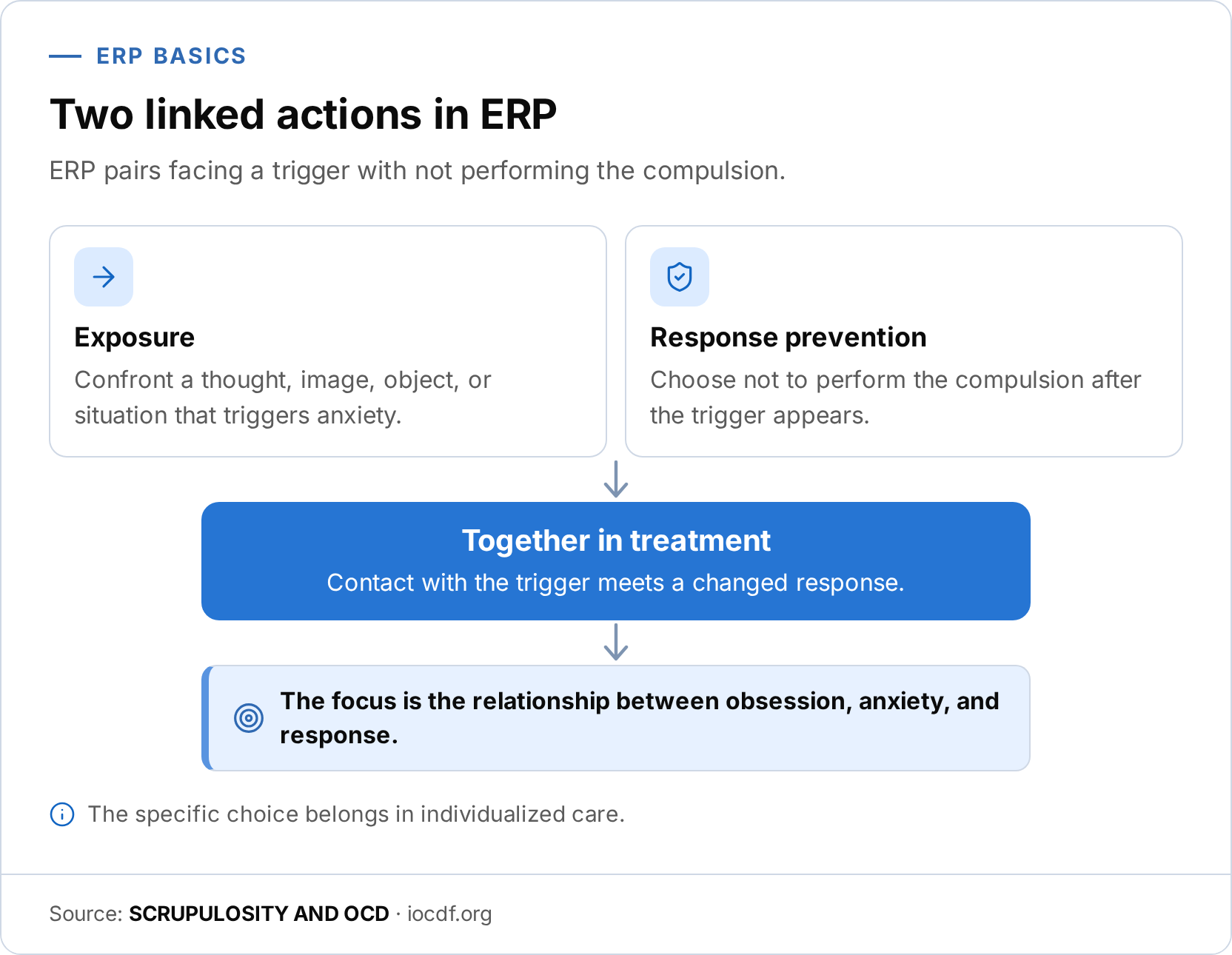
Exposure and response prevention is a form of cognitive behavior therapy used for OCD, including scrupulosity. For scrupulosity, cognitive behavior therapy featuring ERP is described as the primary psychological treatment. Exposure means systematically confronting thoughts, images, objects, or situations that trigger obsessions or anxiety. Response prevention means choosing not to perform the compulsive behavior after the trigger appears.
The two parts belong together. Contact with a feared thought or situation without changing the usual response creates an opportunity to learn that you can experience uncertainty without immediately obeying the compulsion. ERP is not an instruction to force away thoughts, prove that feared outcomes will never happen, or settle a religious question with a therapist’s personal opinion.
For religious or moral fears, the trigger might involve a thought, image, situation, or question connected to sin, guilt, judgment, or religious performance. The response-prevention part concerns the compulsion that follows, such as repeated reassurance, ritualizing, checking, or another response identified in treatment. The specific choice depends on your circumstances and belongs in individualized care.
ERP does not determine your religious obligations. It does not ask you to abandon prayer, reject your tradition, or act against your values. Its focus is the relationship between an obsession, the anxiety it creates, and the response used to obtain certainty or relief.
This distinction matters when the feared topic is spiritually significant. The treatment target is the repetitive response to doubt, not the religious meaning you assign to your life, community, or practices.
What a faith-respecting ERP process may involve
A faith-respecting ERP process may begin with treatment planning rather than an unexpected challenge. Selected ERP guidance describes exposure practices as planned ahead of time, with a therapist coaching and encouraging you through gradually more challenging steps. You are not forced or deceived into exposure.
A therapist may discuss the triggers, thoughts, images, situations, and responses involved in your cycle. The work may include:
- Situational exposure: approaching an actual situation or stimulus connected with the fear.
- Imaginal exposure: working with thoughts or images when a feared outcome cannot be addressed directly in the moment.
- Response prevention: resisting the compulsion during and after the exposure.
- Between-session practice: completing additional ERP practice that your therapist asks you to do.
These categories explain the process; they are not a self-guided assignment. Your therapist would need to decide what is appropriate, how to pace it, and what support or adjustment is needed.
Therapist coaching matters because religious fears can carry shame, grief, or a sense of responsibility that deserves respectful attention. A gradual process should leave room for you to describe what an exercise means to you and to ask how it relates to the compulsion rather than to your beliefs. If a proposed exercise feels confusing, coercive, or disconnected from the agreed treatment goal, raise that concern before proceeding.
ERP may involve discomfort because the usual certainty-seeking response is being interrupted. Discomfort alone does not tell you whether a particular exercise is appropriate. Discuss the reason for the exercise, the response you are practicing, and what you should do if the distress becomes difficult to manage.
A planned process also gives you a chance to understand the purpose of each step before you participate. Ask what the exercise is intended to address, which response you are practicing, and how the therapist will use your feedback to guide later discussion.
The target is compulsive certainty-seeking, not personal belief
The target of ERP for scrupulosity is the OCD pattern, not your personal belief. Selected guidance describes treatment as aiming to separate OCD from your religious and moral values so you can live consistently with those values. That distinction protects your agency: a therapist can help you examine compulsions without becoming the authority who decides what your faith requires.
Moral-scrupulosity guidance describes ERP as approaching triggers that provoke anxiety and uncertainty without avoidance or frantic efforts to relieve doubt or guilt. In practice, the work may involve allowing the question to remain unanswered for a period of time rather than using rumination, research, prayer, reassurance, apologizing, or another response to force a feeling of certainty.
That description does not mean that every question should remain unanswered or that spiritual guidance has no place. It means that the compulsive demand for absolute reassurance is examined as part of treatment. You can distinguish a freely chosen religious practice from a response that feels urgent, repetitive, and driven by the need to neutralize fear.
Compulsive reasoning, rumination, reassurance, avoidance, and related strategies are described in the selected guidance as unable to create certainty or long-term relief and as capable of maintaining distress. This is a reason to discuss the cycle with a qualified therapist, not a reason to accuse yourself of weak faith or bad intentions.
A treatment conversation should make space for your tradition, language, and values. It should also keep clinical work and spiritual authority distinct, especially when you are asking whether a fear reflects OCD or a genuine religious or moral question.
You can bring both sides of that concern into the conversation: what you believe matters to you and what the fear-driven pattern is asking you to do. That fuller description helps keep the focus on your experience rather than on assumptions about a tradition.
What progress can—and cannot—mean
Progress in ERP for scrupulosity can be understood as changing your response to obsessive doubt rather than proving that you are spiritually correct. Treatment aims to help separate OCD from your religious and moral values, while selected guidance describes approaching triggers without avoidance or frantic efforts to eliminate doubt or guilt.
That may mean practicing a more willing response to uncertainty, interrupting a compulsion, or making room for a valued activity without first obtaining complete reassurance. Those are examples of the treatment direction, not predictions about what you will experience or a schedule for improvement. Your therapist would help define meaningful goals with you.
A therapist may ask you to complete additional ERP practice between sessions. Practice may feel uncomfortable, and anxiety may not disappear immediately. The selected guidance specifically describes compulsive certainty-seeking as unable to produce certainty or long-term relief, so the aim is not to win an argument with every fear or obtain complete certainty.
Progress cannot mean any of the following:
- proof that a religious belief or obligation is correct or incorrect;
- a therapist’s decision about your spiritual or moral duties;
- a requirement to abandon valued religious practices;
Use these boundaries to keep expectations honest. A careful consultation can help you discuss what change would matter in your daily life without turning treatment into a promise.
You might also ask how progress will be discussed when uncertainty remains. A useful conversation can distinguish a difficult moment from a failed treatment, while leaving the therapist to determine what adjustments are clinically appropriate.
How faith-sensitive collaboration may fit into care
Faith-sensitive collaboration may include discussion of your values and, when appropriate, consultation with a leader from your faith tradition. International OCD Foundation guidance states that treatment for scrupulosity may include consultation with a leader of your faith tradition.
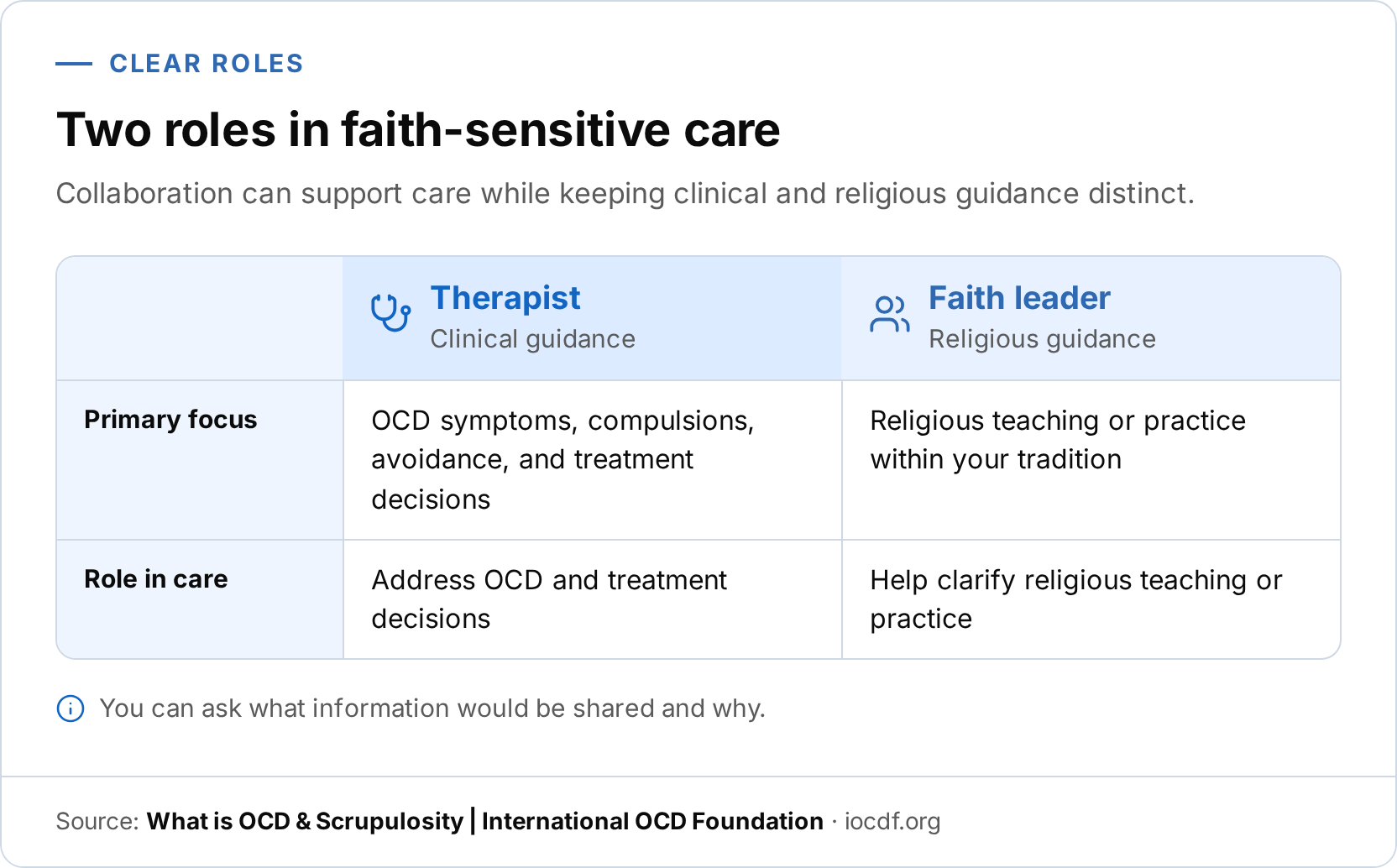
The roles remain different. A therapist can address OCD symptoms, compulsions, avoidance, and treatment decisions. A trusted faith leader may help clarify religious teaching or practice within your tradition. Neither role should require you to surrender your ability to ask questions or to treat every intrusive fear as a spiritual instruction.
A useful collaboration begins with consent and clear boundaries. You can ask what information would be shared, why another person’s input might help, and how your privacy would be handled. You can also say when a discussion feels like reassurance-seeking rather than value-based guidance.
If your concerns involve a tradition, community, identity, or history that a therapist does not understand, ask how the therapist will learn enough to work respectfully. Cultural humility is part of fit. You should not have to defend the legitimacy of your faith in order to discuss the way OCD is affecting you.
You remain entitled to understand who is giving clinical guidance and who is offering religious guidance. Keeping those roles clear can make it easier to ask questions without turning either person into a source of absolute certainty.
Questions to bring to an ERP consultation
A consultation with a therapist gives you a chance to ask how the therapist’s education, training, and specialized certifications relate to your concerns. At The Emerald Couch, we recommend asking about those areas when you are evaluating care. You can bring a written list so that anxiety does not require you to remember every question in the moment.
Questions about clinical fit can include:
- What training and supervised experience do you have with OCD and ERP?
- How do you distinguish religious or moral values from compulsive doubt and reassurance-seeking?
- How would you identify the compulsions or avoidance patterns involved in my concerns?
- How are exposures planned, explained, and adjusted over time?
- How do you make sure exposure is gradual and that I am not forced or deceived into it?
- How might imaginal or situational exposure fit into treatment?
- What would response prevention involve during and after an exercise?
- What kind of practice might you ask me to complete between sessions?
- How do you respond when an exposure brings up shame, grief, or fear of violating a value?
- How do you account for the language, tradition, or community context that shapes my concerns?
Questions about the therapy process can include:
- How often would sessions usually occur, and how long would the initial assessment take?
- How would we decide whether ERP is an appropriate option for my concerns?
- What would happen if distress becomes too intense during or after an exercise?
- How would you coordinate, if appropriate, with a leader from my faith tradition?
- What communication is available between sessions, and what is the boundary for that communication?
- Which session formats do you offer, and what would participation require from me?
- How might between-session practice be discussed if I cannot complete what was planned?
The answers will not provide a diagnosis by themselves. They can help you understand the proposed process and decide whether the conversation feels respectful, clear, and sufficiently collaborative.
You do not need to disclose every private religious detail during a first contact. Share enough to explain the concern, the pattern of doubt or compulsion, and what you want to understand about ERP. A qualified therapist can tell you what information would help with an individualized assessment.
You can also ask what remains undecided after an initial conversation. Fit may depend on the therapist’s understanding of your concerns, the proposed treatment approach, the available format, and your ability to participate in the process.
What to verify before choosing a Denver option
Choosing a Denver option requires more than recognizing the word OCD on a services page. Ask whether the therapist actually offers ERP for the concerns you want to discuss, how the therapist works with religious or moral themes, and whether the pace and format are workable for you. Ask about training and specialized certifications related to your concerns, as The Emerald Couch recommends for consultations.
At The Emerald Couch, we specialize in OCD treatment. We provide therapy for individuals with OCD. Those facts identify a possible starting point for a conversation; they do not establish that a particular therapist has specific religious-OCD expertise or that ERP will be appropriate for you.
Use these fit questions before making a decision:
- Does the therapist explain ERP as exposure plus response prevention rather than as forced confrontation?
- Can the therapist discuss your religious or moral concerns without treating faith itself as pathology?
- Will the therapist explain the purpose and pacing of proposed exercises?
- Can you ask about training, education, and specialized certifications connected to OCD and your concerns?
- Do the session format, communication boundaries, and practical arrangements suit your circumstances?
- Can the therapist explain how your feedback will shape the pace of treatment?
A “yes” to one question does not settle the whole decision. It gives you a clearer basis for deciding whether to continue the conversation.
Keep the question specific to the care you are considering. “Do you treat OCD?” may open the discussion, while “How would you approach religious or moral obsessions and compulsive reassurance-seeking?” can clarify whether the proposed conversation addresses the concern you want to bring.
A transparent Denver or telehealth next step
That gives you two ways to begin an initial conversation about your concerns: in person in Denver or through telehealth. The format does not answer whether ERP fits your situation. Use the consultation to ask about OCD-focused treatment, religious or moral concerns, the proposed process, scheduling, and any clinical questions that affect your decision.
The Emerald Couch’s stated OCD service is a reason to ask about fit, not a guarantee of a particular treatment, outcome, or religious-OCD specialization. You can describe the pattern you are noticing without diagnosing yourself and ask what information would be needed to discuss care responsibly.
If in-person access is difficult, telehealth may be the practical format to discuss. If you prefer face-to-face counseling, Denver appointments may be the relevant format to ask about. Your choice can begin with the setting in which you can speak openly and consider the questions above.
The next conversation can remain exploratory. You can ask what services are available for your concerns without treating an initial discussion as a commitment to begin treatment.
Discuss logistics without treating them as proof of fit
Practical details deserve their own questions rather than being treated as evidence that ERP is clinically appropriate or that a particular therapist will be the right fit for your concerns.
Alongside clinical questions, consider asking:
- What appointment formats and scheduling options are available?
- What would the first conversation cover?
- Which payment details should I clarify before scheduling?
- What questions should I bring about ERP, scrupulosity, and faith-sensitive care?
The answers can help you decide whether to continue exploring care, but they cannot determine diagnosis, treatment suitability, or expected progress.
A clear logistical answer can help you decide whether to continue exploring care. Keep that answer separate from the clinical decision. The right next conversation is one in which you can ask both kinds of questions without treating insurance status, price, or location as proof that a treatment will work for you.
Write down the financial and scheduling answers alongside your clinical questions. Separating these categories can make it easier to notice which questions have been answered and which still need discussion.
A careful decision point for exploring ERP
ERP may be worth discussing with a qualified therapist if obsessive doubt and compulsive certainty-seeking are interfering with how you want to live your religious or moral values. ERP pairs facing triggers with not performing the compulsion afterward, while scrupulosity guidance describes treatment as separating OCD from those values rather than replacing them.
You do not need to diagnose yourself or prescribe an exposure. Bring the pattern, your questions, and your boundaries to an individualized conversation. A qualified professional decides whether a treatment is suitable for your circumstances, and you retain agency over your beliefs and spiritual commitments.
For an adult in Denver who wants to explore this option, the next practical step is a conversation with The Emerald Couch about fit, format, scheduling, and your questions about ERP for religious or moral concerns. That conversation can help you decide whether to continue exploring care without promising a diagnosis, availability, eligibility, specific expertise, or a particular result.
Questions adults may have before discussing ERP for religious OCD
What is exposure and response prevention (ERP) for religious OCD?
ERP is a form of cognitive behavior therapy that involves systematically confronting thoughts, images, objects, or situations that trigger obsessions or anxiety, while choosing not to perform the compulsive behavior that typically follows. This approach aims to help individuals manage their OCD symptoms without compromising their religious beliefs.
How does ERP help with scrupulosity?
ERP helps individuals with scrupulosity by separating their OCD symptoms from their religious and moral values. It encourages them to face their fears without engaging in compulsive behaviors, allowing them to live in accordance with their beliefs while managing their anxiety.
What should I expect during an ERP therapy session?
During an ERP session, you can expect to discuss your specific fears and compulsions with your therapist. The therapist will guide you through exposure exercises, which may include confronting feared situations or thoughts, and will help you practice response prevention techniques.
What questions should I ask a therapist during an initial consultation about ERP?
You may want to ask about the therapist's experience with OCD and ERP, how they plan exposures, how they ensure a gradual approach, and how they will address any discomfort you may experience during the process.
What are the costs associated with therapy at The Emerald Couch?
The Emerald Couch charges $220 for out-of-network therapy sessions and is in-network with Aetna and Lyra insurance plans.
Can I receive therapy remotely or only in-person at The Emerald Couch?
The Emerald Couch offers both in-person therapy at their Denver office and remote telehealth therapy options to accommodate client preferences.
What is the first step to take if I want to explore ERP for religious OCD?
The first step is to schedule a consultation with a qualified therapist at The Emerald Couch to discuss your concerns and determine if ERP is a suitable treatment option for you.
Sources
- SCRUPULOSITY AND OCD — www.google.com
- What is OCD & Scrupulosity | International OCD Foundation — iocdf.org
- Exposure and Response Prevention (ERP) — iocdf.org
- Moral Scrupulosity — www.google.com
- Scrupulosity - Wikipedia — www.google.com, 2005-02-10
- Services — The Emerald Couch
- The Emerald Couch
- Key Questions for Your Consultation with a Therapist, Counselor, or Psychologist — The Emerald Couch
- What to expect from counseling, mental health, psychotherapy, and therapy in Denver — The Emerald Couch