

What PTSD symptoms can—and cannot—tell you
PTSD symptoms can be meaningful signs that trauma is still affecting you, but symptoms alone cannot establish PTSD. The diagnostic framework involves exposure to a traumatic or stressful event, symptoms across four domains—re-experiencing, avoidance, negative thoughts or feelings, and arousal and reactivity—along with symptom duration, related distress or impairment, and consideration of whether another circumstance, such as substance use or a medical condition, better explains what is happening.
Post-trauma reactions do not follow one fixed course. Many people recover from trauma-related reactions over time, while some continue to experience symptoms that may warrant an evaluation for PTSD. A difficult reaction after trauma deserves care and attention even before you know which label, if any, fits.
You can use the four patterns as a way to describe what you notice, not as a test that gives you a diagnosis. Start with three practical questions:
- How long has the reaction been present?
- How much distress does it cause?
- What parts of daily life does it disrupt?
Those questions give you a clearer starting point for a conversation with a qualified professional. You do not need to decide for yourself whether your experience meets diagnostic criteria before asking for support.
Pattern 1: Re-experiencing the trauma
Re-experiencing symptoms are unwanted memories, distressing dreams, or flashbacks connected with a traumatic event. A flashback can feel like reliving what happened and may bring intense fear or panic. These experiences may appear after something reminds you of the event, or they may arise without an obvious reminder.
Trauma reminders can take different forms, so your experience may not resemble anyone else’s. You might notice:
- A memory arriving without your permission.
- A distressing dream that leaves the event feeling close again.
- A flashback that feels more immediate than an ordinary memory.
- Fear or panic after encountering something associated with what happened.
A news report, an accident scene, a smell, or a sound can act as a reminder, depending on what you experienced. The reminder does not have to be obvious for the reaction to feel real.
Re-experiencing alone does not answer whether PTSD fits. An evaluation considers this pattern alongside the other domains, duration, distress, impairment, and other possible explanations. A useful preparation step is to record what seems to bring the memory, dream, or flashback into focus and how you respond afterward. You do not need to describe the event in detail; describing the reaction and its effect on your day can give a professional useful information.
Pattern 2: Avoiding reminders
Avoidance symptoms involve steering clear of reminders, people, situations, conversations, or thoughts connected with the trauma. You may avoid talking about what happened, thinking about it, or entering a setting that brings the event to mind. Avoidance can sometimes affect everyday functioning.
Avoidance can be difficult to recognize because it may look like an ordinary choice in isolation. Look at the pattern over time rather than judging a single decision:
- Which places or situations have become difficult to enter?
- Which conversations or subjects do you keep away from?
- Have activities, relationships, or routines narrowed because of reminders?
- Are you changing plans or responsibilities to avoid encountering something connected with the trauma?
The questions help you describe impact; they are not a diagnostic test. The clinical concern is whether avoidance is connected with the trauma and contributes to problems in everyday functioning.
A written list of avoided situations can help you explain the pattern without forcing yourself to revisit the event all at once. Include what you avoid, what happens when you encounter the reminder, and which part of daily life becomes harder. Bring that description to an evaluation if avoidance is persistent, distressing, or interfering with your routines.
Pattern 3: Changes in thoughts and feelings
Trauma-related changes in thoughts and feelings can include low mood, less ability to feel happiness, reduced interest in activities or people, and memory difficulties. You may notice that experiences which once felt meaningful now feel distant, flat, or hard to access. These changes can involve both how you feel and how you remember or interpret daily experiences.
A careful description can be more helpful than a label. You might write down:
- What you enjoyed or participated in before the trauma and what has changed.
- Whether your mood has stayed low or your ability to feel pleasure has decreased.
- Whether memory problems affect conversations, work, routines, or relationships.
- Which changes feel connected to the event and which began at another time.
These notes do not determine a diagnosis. They give you language for describing changes in thoughts, feelings, memory, and interest. You can also note whether the changes are steady, come and go, or become stronger around reminders.
Changes in thoughts and feelings matter in context. PTSD diagnosis involves symptoms across four domains as well as duration, distress or impairment, and other diagnostic considerations, so a single change in mood or memory cannot establish PTSD by itself. A professional can help separate trauma-related changes from other circumstances that may affect mood, memory, or interest.
Pattern 4: Arousal and reactivity
After trauma, arousal and reactivity can refer to changes in how you feel or react. In an evaluation, this pattern is considered with re-experiencing, avoidance, and negative changes in thoughts or feelings—not in isolation. Symptoms alone do not establish PTSD; an evaluation also considers trauma exposure, duration, distress or impairment, and whether another circumstance better accounts for them.
Arousal and reactivity can describe changes in how you feel or react after trauma, but this label alone does not tell you whether PTSD is present. A qualified assessment considers the full pattern, including exposure to a traumatic or stressful event, duration, distress or impairment, and whether another circumstance better accounts for the symptoms. That is why matching yourself to one description cannot replace an evaluation.
You can bring the question directly into a professional conversation: describe the reactions that concern you, when they began, and how they affect daily life. If you are unsure how to name the reactions, describe what you notice before, during, and after a difficult moment. The goal is not to match yourself to a checklist; the goal is to give a professional enough context to consider the complete diagnostic framework.
When symptoms deserve professional attention
Post-trauma reactions may lessen over time, but persistent or disruptive symptoms deserve attention. Cleveland Clinic advises talking with a healthcare provider if post-traumatic-stress symptoms last more than a month or interfere with daily life. Symptom severity during screening and assessment is also one indicator clinicians consider when evaluating the risk of more persistent traumatic-stress symptoms.
Professional support may be a reasonable next step when:
- Symptoms have continued for more than a month.
- Reactions interfere with work, relationships, routines, or other parts of daily life.
- Avoidance is narrowing where you go, what you do, or whom you see.
- Memories, dreams, or flashbacks bring recurring distress.
- Changes in mood, interest, or memory are difficult to manage.
These signs do not mean that you have PTSD. They indicate that an evaluation could help clarify what you are experiencing.
A short timeline can make an initial conversation easier. Note when the reactions began, whether they are becoming more or less frequent, what seems to trigger them, and which parts of daily life they affect. Include other major stressors or health concerns that may matter to the assessment, since diagnostic considerations include whether another circumstance better explains the symptoms. You can bring a few sentences rather than a complete account.
An evaluation is not a requirement to arrive with the correct label. You can say that you are trying to understand recurring reactions after trauma and want help sorting through their duration, impact, and possible explanations. Seeking an evaluation means asking for clarity; it does not commit you to a particular diagnosis or treatment.
What trauma-informed care should make room for
A trauma-informed approach recognizes trauma’s impact, understands possible paths for recovery, notices signs and symptoms, integrates trauma knowledge into policies, procedures, and practices, and seeks to resist retraumatization. The approach concerns how care is organized and delivered, not a promise that every person will have the same experience.
You can ask how a therapist brings those principles into an initial conversation. Useful questions include:
- How do you learn what feels manageable for me to discuss?
- How do you explain the care process and invite my perspective?
- How do you recognize signs that a conversation needs to slow down or change direction?
- How do you incorporate what you learn about my history into your policies, procedures, and therapy approach?
These questions help you understand whether the therapist’s way of working gives room to your experience and concerns. You can also notice whether the conversation leaves space for your questions rather than requiring you to explain everything at once.
Your background, identity, relationships, and reasons for seeking help are part of the context you bring to care. You can look for a conversation that treats your experience respectfully and does not reduce you to a symptom list. Trauma-informed care should leave room for your perspective, your boundaries, and the pace at which you can discuss what brings you in. For LGBTQIA+ adults and other people from marginalized populations, it can also be important to ask whether the setting feels safe, inclusive, and non-judgmental. The Emerald Couch is dedicated to providing that kind of environment, so you can raise identity-related context or concerns you want included in care. If you are unsure what to share, you can ask directly how identity, culture, relationships, or other context will be considered rather than assuming the therapist will know what matters to you.
A practical Denver next step for adults
The Emerald Couch specializes in treating trauma and anxiety in adults. For adults in Denver who are trying to understand persistent or disruptive reactions after trauma, an initial conversation can focus on what you have noticed, how long it has been happening, and what support you are looking for.
At your first visit, we conduct a thorough intake session to gather information and assess your needs. You can prepare by bringing a brief description of the reactions that concern you, the effect on daily life, and any questions about how therapy would address your goals. You can also say plainly that you are seeking help understanding possible trauma-related symptoms rather than arriving with a diagnosis.
The first conversation does not require you to diagnose yourself before you arrive. It gives you a place to describe what is happening and learn whether the available approach fits the kind of support you want to explore. We specialize in treating trauma and anxiety in adults, so the discussion can stay focused on your concerns and the goals you bring to care.
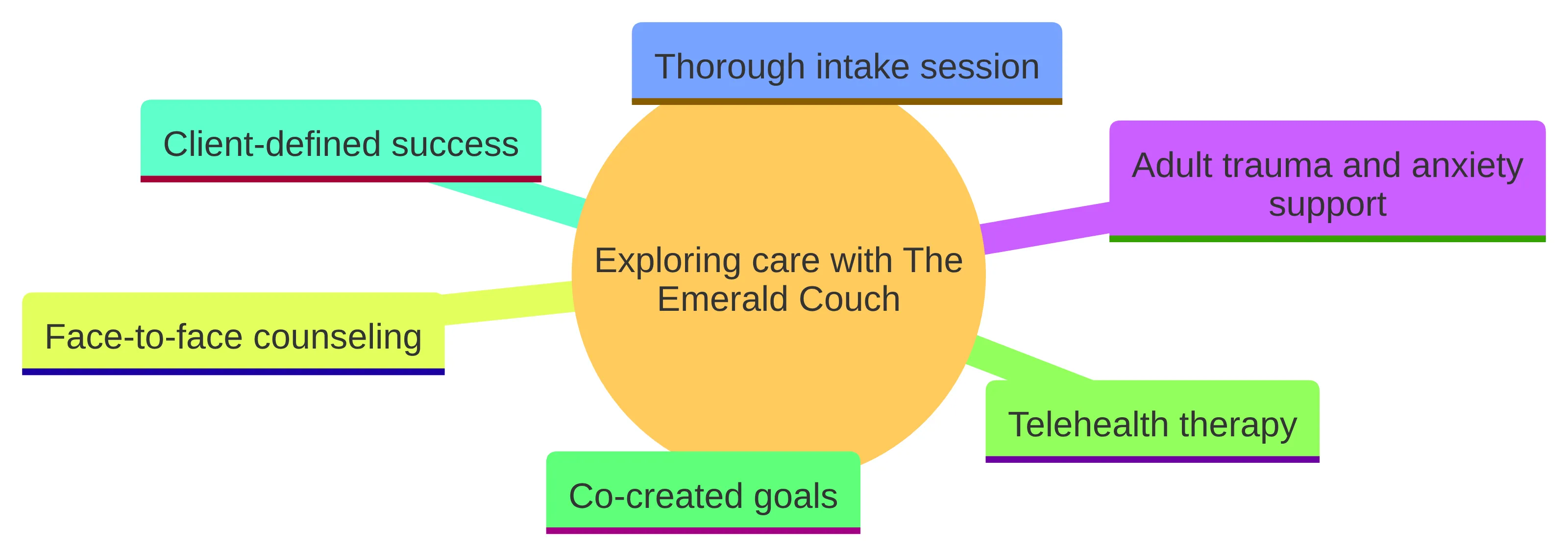
What exploring care with The Emerald Couch may look like
The Emerald Couch offers both face-to-face counseling and telehealth therapy. That gives adults considering care in Denver two stated formats to discuss when deciding what setting fits their circumstances. You can consider which setting makes it easier for you to take part in an initial conversation and continue with the format you choose.
At The Emerald Couch, our therapy involves exploring thoughts, feelings, and behaviors and may include reflecting on emotional or physical responses. An early conversation can therefore include both the reactions you notice and the way those reactions affect your daily life. You can begin with the concern that feels easiest to describe and add context as the conversation develops.
Rachel Kirkman has experience using Cognitive Processing Therapy, also called CPT, and Eye Movement Desensitization and Reprocessing, also called EMDR, for traumatic experiences. You can ask how either method might relate to your concerns, what participation would involve, and how your goals would shape the conversation. Experience with a method is not a promise that it will be the right fit for you, so the introductory discussion should leave room for your questions and preferences.
The purpose of discussing format and therapeutic approach is to understand what care may involve, not to select a label from a list. Describe the symptoms or reactions you want to address, ask how the therapist would approach them, and notice whether the explanation is clear enough for you to make an informed choice about continuing the conversation.
Questions to bring to an introductory conversation
An introductory conversation can help you ask focused questions instead of trying to explain everything at once. The questions below cover therapist skill, goals, session structure, and format. Choose the questions that address your immediate concern; you do not need to ask all of them.
Therapist experience matters when you are deciding whether to continue a conversation. Ask:
- What experience do you have with trauma-related concerns like the reactions I am describing?
- How do you work with the areas I hope to approach?
- How might you help me understand whether CPT, EMDR, or another approach fits my goals?
The Emerald Couch recommends looking for a therapist who is skilled in the areas you hope to approach. A direct answer can help you understand whether the conversation is relevant to the concerns you want to address.
Goals give the conversation a direction without requiring you to predict the whole course of therapy. Ask:
- How will we decide what to focus on first?
- How will we identify what success looks like for me?
- How will my goals shape the work if my needs change?
At The Emerald Couch, we co-create goals with clients and identify what success looks like for them. You can describe a concrete change you hope to understand or work toward, even if you are not ready to define a larger outcome.
Session structure can affect whether care fits your life. Ask about appointment frequency and duration, since The Emerald Couch recommends discussing those policies when considering a therapeutic relationship. You can also ask whether face-to-face counseling or telehealth would be available for your care, because The Emerald Couch offers both formats. These questions keep the conversation practical while you decide whether the setting and working style fit your needs. Before deciding whether to continue, you can summarize what you learned in three lines: relevant experience, how the work would be shaped around your goals, and practical arrangements such as frequency, duration, and format. If any line remains unclear, that uncertainty is itself a reason to ask a follow-up question rather than infer an answer. Your summary can also show which question remains unanswered, such as what the therapist would assess first or how your goals would be revisited during an initial conversation. This keeps the decision grounded in information you received and in the concerns you want to address, without requiring you to make a diagnosis or promise a particular outcome.
A calm decision point for seeking support
Recognizing one or more symptom patterns is not the same as receiving a PTSD diagnosis. If symptoms last more than a month or interfere with daily life, consider talking with a healthcare provider. A qualified professional can determine whether PTSD fits your experience and consider duration, distress or impairment, and other possible explanations.
The Emerald Couch specializes in treating trauma and anxiety in adults in Denver. If you want to explore whether an adult-focused, trauma-informed conversation fits your needs, you can begin by describing what you have noticed, how it affects daily life, and what you hope to understand. That is enough to start the conversation without deciding the diagnosis yourself.
Questions adults may have about PTSD symptoms and evaluation
What are common PTSD symptoms in adults?
Common PTSD symptoms include re-experiencing the trauma through intrusive memories or flashbacks, avoidance of reminders related to the trauma, negative changes in thoughts and feelings, and heightened arousal and reactivity. These symptoms can significantly impact daily life.
When should someone seek professional help for PTSD symptoms?
Consider seeking professional help if PTSD symptoms persist for more than a month or interfere with daily life, such as work, relationships, or routines. An evaluation can help clarify the nature of the symptoms and whether they warrant a diagnosis.
What should I expect during my first visit to The Emerald Couch?
During your first visit, The Emerald Couch conducts a thorough intake session to gather information and assess your needs. You can prepare by bringing a brief description of your symptoms and any questions you have about therapy.
What is the cost of therapy sessions at The Emerald Couch?
The out-of-network rate for therapy at The Emerald Couch is $220 per session.
How can I prepare for a consultation with a therapist?
To prepare for a consultation, consider writing down your symptoms, how they affect your daily life, and any specific goals you have for therapy. This can help guide the conversation and ensure you cover your concerns.
Sources
- Trauma-Informed Care in Behavioral Health Services — library.samhsa.gov
- What is Posttraumatic Stress Disorder (PTSD)? — www.psychiatry.org
- VA.gov | Veterans Affairs — www.ptsd.va.gov
- Post-Traumatic Stress Disorder — www.nimh.nih.gov
- Trauma-Informed Approaches and Programs — www.samhsa.gov
- What Is Post-Traumatic Stress Disorder (PTSD)? — my.clevelandclinic.org
- What to expect from counseling, mental health, psychotherapy, and therapy in Denver — The Emerald Couch
- About — The Emerald Couch
- The Emerald Couch
- Finding the right therapist for your needs — The Emerald Couch
- Key Questions for Your Consultation with a Therapist, Counselor, or Psychologist — The Emerald Couch