

Start with OCD- and phobia-specific approach questions
The Emerald Couch offers psychotherapy services in Denver. We specialize in treating trauma and anxiety in adults, and we offer psychotherapy services in Denver. This guide cannot determine whether you have anxiety, OCD, or a phobia. It can help you decide whether the concerns affecting your daily life fit the areas we describe, whether our treatment conversation sounds useful, and whether the practical arrangements make sense for you. Individual suitability is something to discuss with a qualified mental health professional.
Start with four questions:
- What concern do you want to bring into therapy?
- What would you like to understand, change, or handle differently?
- Would face-to-face counseling or telehealth fit your circumstances better?
- Do the consultation, scheduling, and financial details work for you?
A clear answer to these questions gives you a better basis for contacting a Denver therapist than choosing by a service label alone. It also leaves room for the conversation to refine your goals.
For an OCD- or phobia-related concern, make the treatment conversation specific. Ask how the therapist explains the concern, how Exposure and Response Prevention would be discussed in relation to your goals, and how goals would be defined together. We offer evidence-based treatments including Exposure and Response Prevention, and we co-create goals with you; these are topics to clarify rather than conclusions about which treatment you need. The Emerald Couch states that it specializes in treating trauma and anxiety in adults, so an adult in Denver exploring anxiety-related care may have a reasonable basis for an initial conversation. That statement is a service scope, not a diagnosis or a promise of a particular result.
If your main concern is outside the areas you want to discuss, bring that boundary into the first conversation rather than assuming the fit. If the focus seems aligned, use the sections below to prepare specific questions about treatment, collaboration, format, cost, and what an initial visit involves.
Define the concern and progress you want to discuss
Your consultation will be more useful when you can describe what anxiety-related concern is interfering with daily life and what you want to explore. The Emerald Couch describes its work as helping you notice thoughts, feelings, physical responses, and the ways those responses affect behavior. You do not need a diagnosis or a polished explanation before you begin.
Use a short preparation note with three parts:
- What is happening: Write down the situations, thoughts, feelings, physical responses, or behaviors you want to discuss.
- Where it matters: Note the areas of life that feel affected, such as work, relationships, routines, travel, sleep, or making decisions. Choose only the areas that are relevant to you.
- What you want from therapy: Describe a change in ordinary language, such as understanding a recurring pattern, responding differently in a difficult situation, or having more clarity about your next step.
This note is not a self-assessment. It is a way to give the therapist a starting point without having to remember every detail in the moment.
Your goals can be specific without being fixed forever. We co-create goals with you and identify what success looks like for you, and you may adjust short- and long-term goals as therapy evolves. That means you can bring both an immediate concern and a broader hope to the conversation.
Try finishing these sentences before you speak with a therapist:
- I want help understanding…
- I notice this concern most when…
- I would like daily life to feel different in the area of…
- I would know we were making useful progress if…
- I am unsure about…
The last sentence matters. Questions about treatment, pace, privacy, cultural or identity-related needs, and scheduling belong in the discussion too. You are not required to arrive with a complete treatment plan; you are bringing information that can help shape one.
Check the stated concern areas before comparing approaches
The Emerald Couch states that it specializes in OCD treatment and is trained to help clients overcome OCD and find comfort. We also provide therapy for trauma, anxiety, including OCD and phobias, and depression. We specialize in treating trauma and anxiety in adults.
These statements give you a way to decide what to bring into an initial conversation. You might describe recurring anxiety, concerns related to OCD, fear or avoidance connected with a phobia, or another issue that you want to understand alongside anxiety. You do not need to decide which diagnostic category applies before speaking with a qualified professional.
Service scope and personal fit are different questions. A practice may state that it treats a concern, while your consultation still needs to clarify how the therapist understands your particular situation, what treatment options may be discussed, and whether the working relationship feels appropriate.
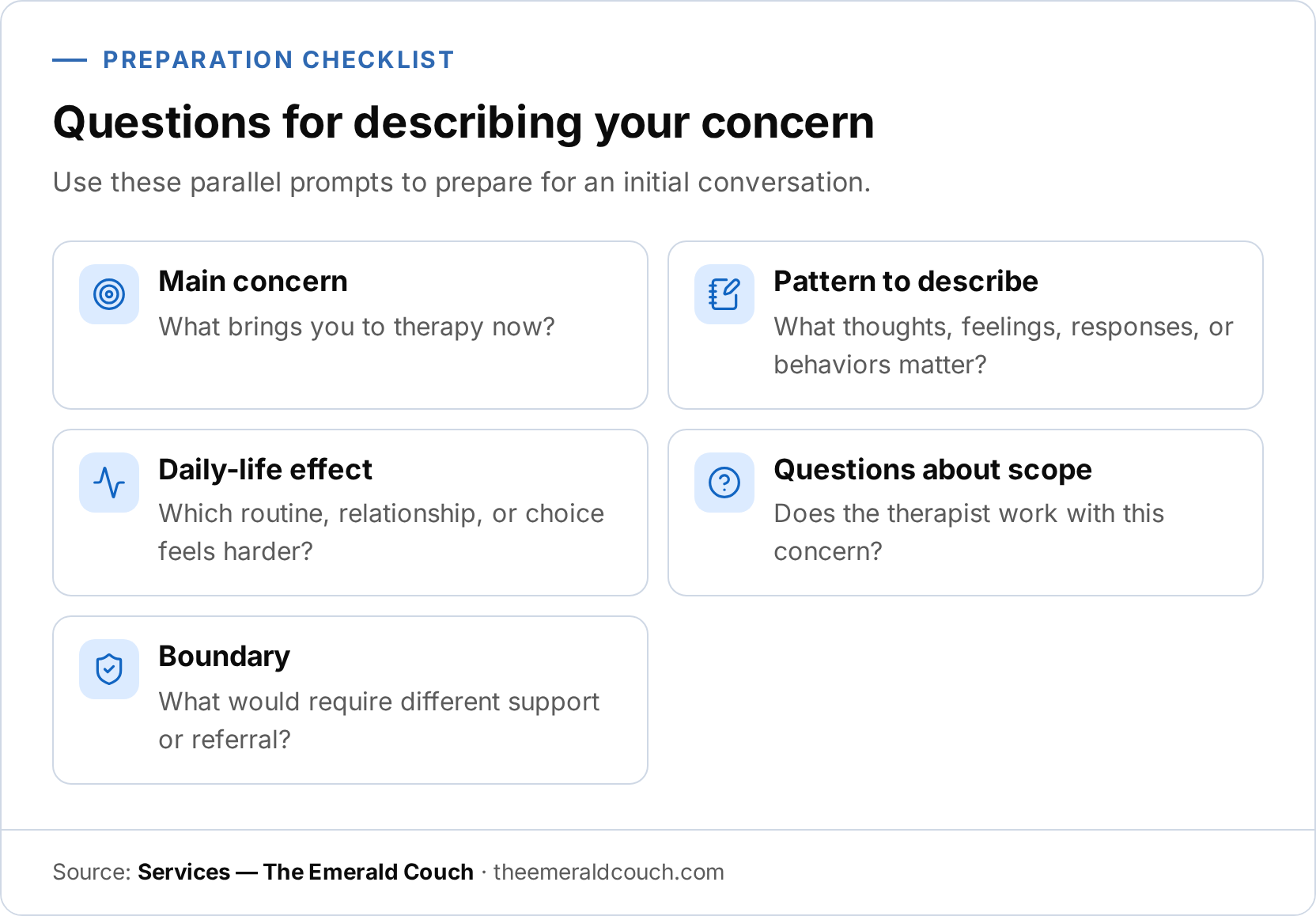
Use this concern-area checklist when preparing your questions:
- Main concern: What brings you to therapy now?
- Pattern to describe: What thoughts, feelings, physical responses, or behaviors do you want to explain?
- Effect on daily life: Which routine, relationship, responsibility, or choice feels harder because of the concern?
- Questions about scope: Does the therapist work with the concern you want to discuss, and how would that concern shape the first conversation?
- Boundary: What would require a different type of support or referral?
The checklist helps you distinguish a relevant service description from a personal clinical decision. It also keeps the conversation focused on your experience rather than on trying to select a diagnosis from a list.
Compare how treatment would be explained and tailored
Treatment approaches should be discussed in relation to your concern and goals, not chosen from a name alone. We provide education, explain our understanding of your situation, and customize scientifically-backed treatments. We list evidence-based treatments including Cognitive Processing Therapy, EMDR, and Exposure and Response Prevention.
Ask what each proposed approach is intended to address in your situation and how the therapist would explain its role. Useful questions include:
- What concern would this approach target?
- How would you know what to work on first?
- What would sessions involve at the beginning?
- How would my goals influence the plan?
- How could we revisit the plan if it does not feel like the right fit?
The purpose of these questions is clarity. A treatment name can tell you something about the clinician’s stated methods, but it does not by itself tell you how those methods would be used with you.
For an OCD- or phobia-related concern, the pattern you describe can change the questions you bring to the treatment conversation. These concerns can both involve fear or avoidance, but they are not automatically the same discussion. This comparison is not a way to decide whether you have OCD or a phobia; it is a way to describe your experience more precisely without diagnosing yourself.
If you are bringing an OCD-related concern, ask how the therapist would explain the relationship between the concern, compulsions, and the responses you want to discuss. You can also ask how Exposure and Response Prevention would be described in relation to your goals, what response prevention would mean within the proposed work, and how you would understand the purpose of the approach before deciding whether the conversation feels clear. The aim is not to arrive knowing that ERP is appropriate. The aim is to learn how the therapist connects the approach to the pattern you described.
If you are bringing a phobia-related concern, ask how the therapist would understand the feared situation, the avoidance connected with it, and the change you would want to work toward. Ask what approach would be considered, how the therapist would explain its role, and how your goals would shape the conversation. You can describe the situation you find difficult and what you currently do in response without deciding in advance which clinical category applies.
A short comparison note may help you prepare:
- What I want to describe: the thoughts, situations, feelings, physical responses, or behaviors that bring me to therapy.
- For an OCD-related conversation: what I want to understand about compulsions and how Exposure and Response Prevention would be explained in my situation.
- For a phobia-related conversation: what feared situation I want to discuss, how avoidance affects daily life, and what I would want clarified about a possible treatment approach.
- Questions for either conversation: how the therapist understands the pattern, how the proposed approach connects to my goals, and what information would be gathered before the plan is tailored.
This distinction gives you a more useful basis for comparing treatment explanations than simply looking for a familiar therapy label. It also leaves room for the therapist to clarify that your concern does not fit the assumption you brought in, or that another conversation is needed before an approach is considered.
A Cochrane review reported that it was not clear whether CBT reduced anxiety more than psychodynamic or supportive therapy, and studies comparing CBT with supportive therapy showed differing results. That finding does not identify one approach as the right choice for every person, and it does not decide what a clinician may recommend in an individual situation.
Use the evidence question carefully: ask how the therapist connects the proposed approach to the concern you described, what alternatives may be relevant, and how you would discuss progress. The conversation should leave you with an understandable reason for the plan rather than a treatment label that you are expected to accept without explanation.
Look for collaboration, clarity, and respect for your preferences
Therapist fit includes the way you are invited into the work. We aim to provide a safe, nonjudgmental space where you can share openly and know you are not alone. We also co-create goals with you and identify what success looks like for you.
A respectful consultation should give you room to ask for explanations, name preferences, and raise concerns about pace or communication. That includes cultural, identity, relationship, and access considerations that affect whether you can participate comfortably. The Emerald Couch is committed to an inclusive, nonjudgmental environment for LGBTQIA+ adults and other marginalized communities.
You can ask:
- How will you explain your understanding of my concern?
- How much choice will I have in setting goals and discussing treatment options?
- How can I tell you when the pace or approach does not feel workable?
- How do you make room for my cultural background, identity, relationships, or preferences?
- What qualifications, training, or specialized certifications relate to my concerns?
These questions do not require you to make a decision during the conversation. They help you notice whether the interaction gives you enough clarity and respect to continue asking questions.
Consider a therapist’s qualifications, experience, therapeutic methods, and whether the therapist feels right for you. You can ask about educational background, training, and specialized certifications related to your concerns. You can also schedule an initial consultation to discuss those concerns and learn how the therapist approaches therapy.
A useful fit check has two sides: the therapist can explain the proposed work clearly, and you can speak openly enough to ask for clarification. If you leave with unanswered questions, write them down and bring them into the next conversation rather than treating uncertainty as agreement.
Understand the intake process and how goals may evolve
The first visit at The Emerald Couch includes a thorough intake session to gather information and assess your needs. Therapy is described as a process rather than a one-time appointment; it is not linear or one-size-fits-all.
That description gives you a practical expectation for the beginning of care. You may spend early conversations explaining what brings you in, identifying the areas you want to address, and discussing a possible direction for treatment. The first visit is not a promise that every question will be settled immediately.
Bring the preparation note from the earlier section, along with questions about:
- What the first visit is designed to cover
- How your concerns will inform the treatment conversation
- How goals will be recorded or revisited
- What you can do if your priorities change
- How appointment frequency and duration will be discussed
The aim is to understand the starting point well enough to have a clearer next conversation.
Your short- and long-term goals may change as therapy evolves. You might begin with one immediate concern and later identify another goal that deserves attention, or you might describe your original goal more precisely after learning more about your patterns.
Use that possibility as a reason to value clear communication, not as a prediction about your progress. Ask how you and the therapist would notice that your priorities have changed and how a revised goal would affect the plan. The answer can help you judge whether the process leaves room for your experience rather than requiring you to follow a fixed script.
Choose the format and schedule you can realistically use
The Emerald Couch offers psychotherapy services in Denver through face-to-face counseling and telehealth therapy. Your format decision can stay practical: consider which setting you can attend, where you can speak privately, and which arrangement fits the routine you are trying to maintain.
| Question | Face-to-face counseling | Telehealth therapy |
|---|---|---|
| Where would you participate? | At the Denver office | From a location suitable for a private session |
| What should you consider first? | Travel and in-office comfort | Privacy, technology, and a workable session space |
| What should you ask about? | Office scheduling and appointment availability | Telehealth scheduling and any participation requirements |
The table is a planning aid, not a claim that one format is better. Choose the option you can discuss openly and attend with enough consistency for the arrangement to be workable.
Scheduling fit deserves the same attention as location. Ask about appointment frequency and duration when assessing whether the therapeutic relationship fits your needs. You can ask how often appointments are typically discussed, how long sessions last, and what happens when your availability changes.
Keep your question concrete: explain the time constraints that matter to you, then ask what scheduling arrangements may be possible. The answer will help you compare the practical fit of care without assuming that a particular frequency or duration is appropriate for everyone.
Verify insurance and out-of-network cost before booking
The Emerald Couch is in-network with Aetna and Lyra. Our out-of-network rate is $220 a session. These are the supplied practice details to bring into your financial questions; they do not determine your individual benefits, coverage, payment responsibility, or reimbursement.
Before you arrange ongoing care, ask how the listed information applies to your situation. Useful questions include:
- Does my plan and type of coverage apply to the service I am considering?
- What would I pay for a session under my plan?
- If I use the out-of-network rate, what amount is due per session?
- Which session formats are available at the rate or network arrangement being discussed?
- Who can explain a billing question if my plan gives me a different estimate?
Treat cost as part of fit, not as a separate detail to address after you have committed to a schedule. Clear financial questions can help you decide whether to continue the conversation.
A network name or session rate cannot tell you what your plan will pay in your particular circumstances. Ask for the current application of these details to your situation and keep the answer with your other consultation notes. If the financial arrangement does not fit your limits, say so directly and use that information in deciding what option to pursue.
Use one final fit check before contacting the practice
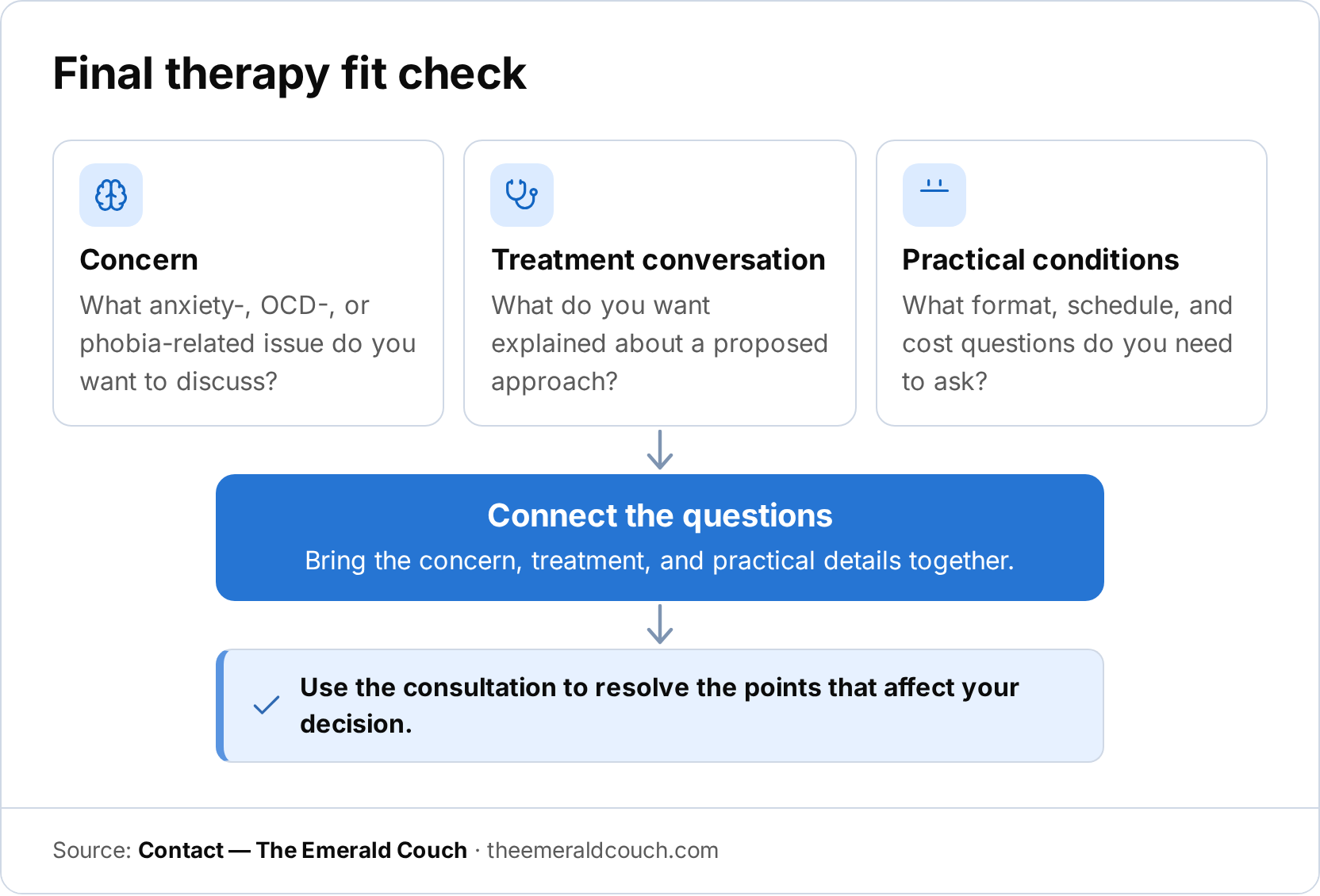
Your final fit check should connect the concern you want to discuss with the treatment conversation and the practical conditions of care. The Emerald Couch specializes in OCD treatment and states that it offers face-to-face counseling and telehealth therapy. We also provide education, explain our understanding of your situation, and customize scientifically-backed treatments.
Before contacting us, make sure you can answer these questions in your own words:
- Concern: What anxiety-, OCD-, or phobia-related issue do you want to discuss?
- Daily-life effect: Where does that issue matter most to you?
- Treatment conversation: What do you want explained about Cognitive Processing Therapy, EMDR, Exposure and Response Prevention, or another approach that may be discussed?
- Collaboration: What do you need from the therapist in order to ask questions and participate in goals?
- Process: What do you want to know about the first intake and how goals may change?
- Format: Would Denver face-to-face counseling or telehealth be more workable for you?
- Schedule: What frequency and duration questions do you need to ask?
- Cost: How will you ask about Aetna, Lyra, or the $220 out-of-network session rate?
You do not need every answer before making contact. You do need enough clarity to explain your concern and identify the questions that remain.
Use the consultation to resolve the points that affect your decision. We offer a free 30-minute consultation to better understand your needs.
If the concern area, treatment explanation, collaborative style, format, schedule, or financial arrangement does not fit what you need, you can leave the conversation with a clearer basis for pursuing another suitable Denver option.
Take the next step when the fit checks align
The Emerald Couch may be worth an initial conversation if you are an adult in Denver exploring therapy for anxiety, OCD, or phobias and the stated concern areas, treatment discussion, collaboration, format, schedule, and financial details fit what you want to consider. Use that conversation to describe what is affecting you, ask how the therapist approaches therapy, and clarify the current logistics that matter to your decision.
A qualified mental health professional decides individual suitability; this guide cannot make that decision for you. If the conversation gives you enough clarity and the arrangement fits your needs, you can decide whether to continue with The Emerald Couch or pursue another suitable Denver option.
Questions to resolve before choosing anxiety, OCD, or phobia therapy
What types of therapy does The Emerald Couch provide for anxiety and OCD?
The Emerald Couch specializes in treating trauma and anxiety in adults, including OCD and phobias. They offer evidence-based treatments such as Cognitive Processing Therapy, EMDR, and Exposure and Response Prevention.
How can I prepare for my first consultation at The Emerald Couch?
Before your first visit, consider writing down your main concerns, how they affect your daily life, and what you hope to achieve through therapy. This preparation will help guide your conversation with the therapist.
What should I know about the costs of therapy at The Emerald Couch?
The Emerald Couch is in-network with Aetna and Lyra, and the out-of-network rate is $220 per session. It's important to verify how your insurance applies to the services you are considering.
What can I expect during the intake process at The Emerald Couch?
During the first visit, The Emerald Couch conducts a thorough intake session to gather information about your needs and concerns.
How does The Emerald Couch ensure a collaborative therapeutic relationship?
The Emerald Couch emphasizes co-creating goals with clients and aims to provide a safe, nonjudgmental space where clients can share openly and feel respected throughout the therapy process.
Sources
- Conquer Stupid Anxiety: Recognize, Manage, and Seek Support — www.google.com, 2026-07-09
- How This Works — The Emerald Couch — www.theemeraldcouch.com
- Psychological therapies for generalised anxiety disorder - Hunot, V - 2007 | Cochrane Library — www.cochranelibrary.com
- Services — The Emerald Couch — www.theemeraldcouch.com
- Contact — The Emerald Couch — www.theemeraldcouch.com
- The Emerald Couch
- What to expect from counseling, mental health, psychotherapy, and therapy in Denver — The Emerald Couch
- Key Questions for Your Consultation with a Therapist, Counselor, or Psychologist — The Emerald Couch