

Start by checking fit before committing to OCD therapy
In-person OCD therapy in Denver is worth assessing by more than distance. You need to know whether the therapist can speak clearly about OCD treatment, whether face-to-face care fits your routine, and whether the scheduling and financial details are workable before you commit to ongoing sessions.
Our stated service gives you a concrete starting point: we provide therapy for individuals with OCD, specialize in OCD treatment, and offer face-to-face counseling as well as telehealth therapy. Those facts identify a relevant option, but they do not settle whether the approach, therapist, office, schedule, or cost fits your circumstances.
Use this guide as a pre-booking conversation plan:
- Check whether the therapist has a clear OCD-specific treatment approach.
- Ask how exposure and response prevention, or ERP, is provided in practice rather than relying on a treatment label alone.
- Consider comfort, identity, office convenience, appointment frequency, and session duration.
- Clarify whether the first contact is a consultation, an intake, or another appointment.
- Ask how insurance and the out-of-network rate apply to the service you are considering.
The decision is not simply whether an office is nearby. It is whether the clinical approach, personal fit, and practical terms line up well enough for you to take the next step. You can use the same questions whether you are beginning to search or comparing an option you have already found.
Use OCD-specific treatment knowledge as your first checkpoint
Exposure and response prevention (ERP) is a type of cognitive behavior therapy (CBT) used for OCD. The 2013 APA guideline recommended beginning OCD treatment with ERP and identified ERP as having the strongest evidence supporting its use in OCD treatment.
That recommendation gives you a useful topic for a first conversation. It does not determine which treatment is suitable for you or tell you how an individual therapist would structure your care. Instead, use it to ask whether the person you are considering can explain OCD-specific treatment in clear, practical terms.
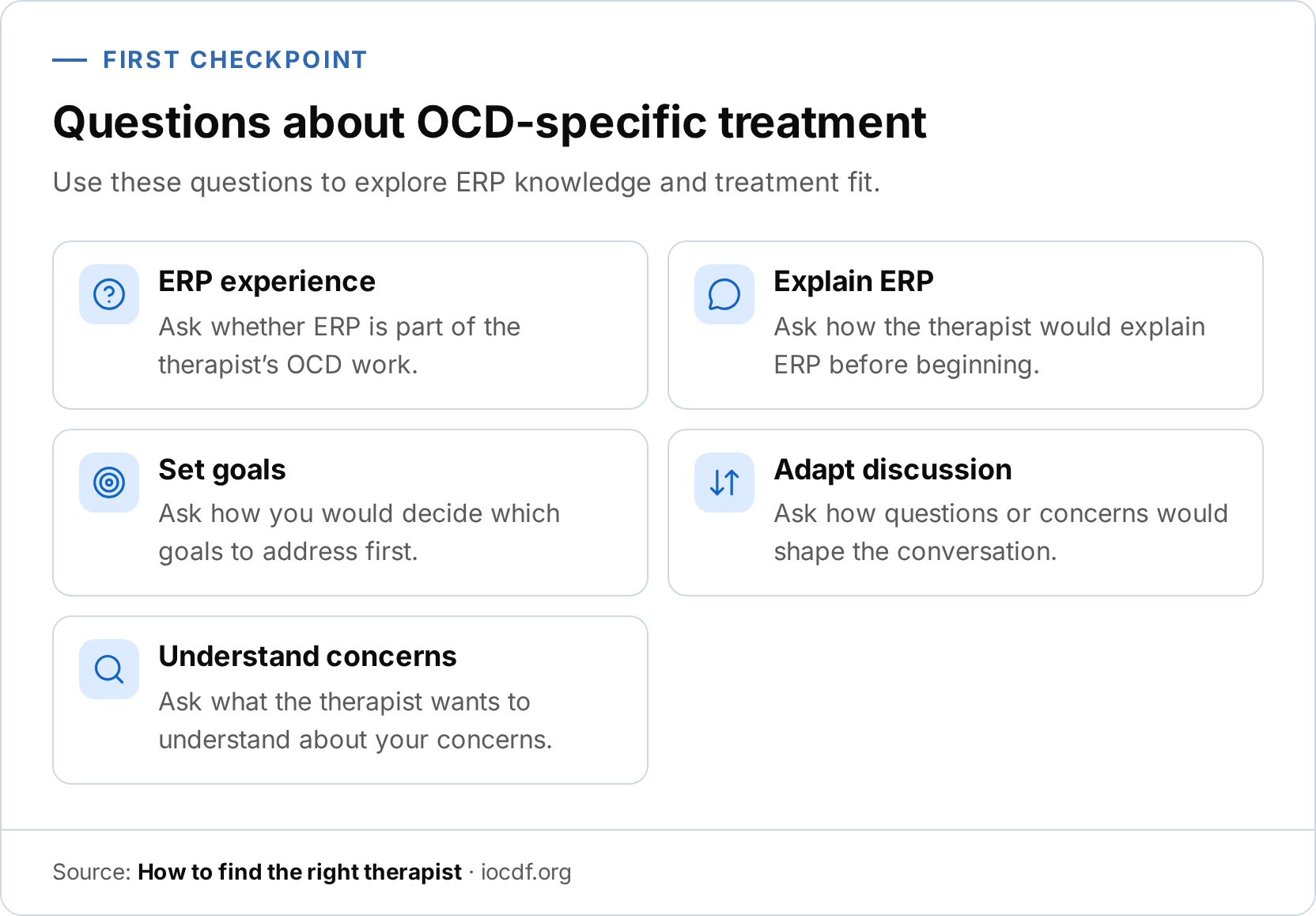
Ask questions such as:
- Is ERP part of your work with adults who have OCD concerns?
- How do you explain ERP before beginning it?
- How would you and I decide what goals to address first?
- How would you adapt the conversation if I have questions or concerns about the approach?
- What would you want to understand about my concerns before discussing treatment?
A useful answer should help you understand what the therapist means by ERP and how you would participate in planning. You are not looking for a treatment name by itself. You are listening for an explanation that connects the approach to your goals and leaves room for questions.
This checkpoint also helps you separate OCD-specific knowledge from general anxiety language. A therapist may work with anxiety broadly, but you can still ask directly how that work applies to OCD. If the answer stays vague, add the question to your list for the introductory conversation rather than assuming the fit.
You can also notice whether the therapist explains the approach in a way you can follow. Clear language does not settle every clinical question, but it gives you a better basis for deciding whether you want to continue the conversation. Ask for clarification when a term or proposed step is unfamiliar.
Ask how the therapist provides ERP in practice
An ERP conversation should tell you more than whether a therapist recognizes the acronym. IOCDF guidance recommends asking prospective therapists whether they know how to provide ERP well because some therapists are better at treating OCD than others.
Ask the therapist to describe the work in language you can understand. You might ask:
- What does ERP look like in your OCD treatment work?
- How would you explain the purpose of an exercise or discussion before we begin?
- How do you invite questions about the pace or structure of treatment?
- How do my goals shape the work?
- How would you and I discuss a concern about an exercise or part of the plan?
Our service information says that we use ERP in OCD treatment. We also co-create goals with clients and identify what success looks like for them. Those statements give you two specific topics to explore: how ERP is explained and how your goals enter the treatment conversation.
You can listen for whether the explanation is direct, whether the therapist answers the question you asked, and whether you understand what the first stages may involve. You can also ask who would provide the treatment, what experience that clinician has with OCD, and how the clinician would discuss your concerns. Those are questions for the conversation, not facts to assume in advance.
A therapist’s willingness to explain the approach matters because you will need enough clarity to decide whether you are comfortable continuing the discussion. If the explanation does not answer your question, ask for a more concrete example or leave that issue open before choosing ongoing sessions.
Your own goals can make this discussion more specific. You might want to talk about how OCD affects work, relationships, routines, sleep, or time spent responding to unwanted thoughts. You do not need to arrive with clinical terminology. Describe the pattern as you experience it and ask how the therapist would connect that information to the treatment discussion.
If the conversation includes a proposed pace or exercise, ask what part you would be expected to understand before moving forward. The point is not to demand a fixed script. It is to learn whether the therapist can explain the approach, answer questions, and include your goals in the planning process.
Separate The Emerald Couch’s stated services from details to verify
The Emerald Couch’s stated OCD services give you a defined set of facts to take into the decision. The Emerald Couch provides therapy for individuals with OCD. The Emerald Couch offers face-to-face counseling as well as telehealth therapy.
The Emerald Couch lists Cognitive Processing Therapy, Prolonged Exposure, EMDR, and ERP for issues including PTSD, generalized anxiety disorder, OCD, phobias, depression, and life transitions.
These statements describe the services we offer. They do not answer every question that can affect your choice. Before you commit to ongoing care, ask:
- Which clinician would work with you?
- What OCD-focused training and experience does that clinician bring to the work?
- Is face-to-face OCD therapy available with the clinician you would meet?
- How is ERP used in the treatment plan you would discuss?
- What appointment times and session length are available?
Current availability, the exact appointment pathway, and the details of your work with a particular clinician belong in the conversation. Do not infer those details from a general service list. Use the stated OCD focus and face-to-face option as reasons to ask focused questions, then make your decision from the answers that apply to you.
The list of approaches also does not mean that every approach applies to every concern or every appointment. Ask which approach the clinician would discuss for your situation and how that discussion relates to the goals you bring. This keeps a general service description separate from an individualized plan.
Location matters for an in-person decision, but it is only one part of access. Consider travel time, transportation, work or caregiving responsibilities, and whether you can attend at the times offered. If those details are not workable, the availability of telehealth may be a useful question, but do not assume that every format applies to every clinician or appointment.
Test the in-person experience against your daily life
In-person therapy needs to fit your daily life as well as your treatment questions. IOCDF guidance identifies office convenience and your comfort with the therapist as practical factors to consider, alongside insurance. Those factors can shape whether attending sessions is workable for you over time.
Use a short fit check before you contact the office:
- Travel: How would you get to the Denver office, and would the route work with your regular commitments?
- Format: Do you want face-to-face sessions, and would telehealth be useful for any later scheduling problem? We offer both face-to-face counseling and telehealth therapy.
- Personal comfort: Do you feel able to speak openly with the therapist? Do you feel that your identity, culture, relationships, and lived experience can be treated with respect?
- Schedule: How often would sessions occur, and how long would each session last? We recommend discussing policies about appointment frequency and duration.
- Continuity: If your preferred appointment time is unavailable, what other times or formats could you discuss?
You do not need to predict every future scheduling issue. You do need enough practical information to decide whether attending an office in Denver is realistic. Ask whether the format you want is available for the clinician and service you are considering instead of assuming that every listed option applies in the same way to every appointment.
Comfort is also more specific than liking an office or having a pleasant first conversation. Consider whether you can ask direct questions, whether the explanations make sense to you, and whether the therapist responds in a way that lets you participate in decisions about your goals. If a personal or practical concern remains unresolved, make it part of the first conversation.
Cultural and personal fit can be discussed directly. You can ask how the therapist approaches your identity, family structure, relationships, faith, military experience, sexuality, gender, or other parts of your life that affect how you experience care. You do not need to justify why respectful, inclusive communication matters to you.
A face-to-face preference can also change over time. You might want office visits as your usual format while keeping telehealth as a question for a later scheduling conflict. The relevant decision is whether the available arrangement fits the circumstances you are discussing, not whether one format is universally preferable. To make that judgment less abstract, sort your questions into three groups before contacting the office: treatment questions, fit questions, and practical questions. Mark each as answered, needs verification, or a deal-breaker for you. For example, an unanswered question about how ERP would be explained belongs in treatment; whether you can speak comfortably with the clinician belongs in fit; and appointment frequency, duration, format, and cost belong in practical planning. This does not score a therapist or predict the course of care. It simply keeps a convenient location from deciding the choice by itself and shows you what to ask first. If several practical details remain unknown, make them part of the initial conversation rather than treating the general service description as confirmation.
Use the first conversation to clarify fit and process
A first conversation can help you distinguish an introductory discussion from the start of ongoing therapy. At the first visit, we conduct a thorough intake session to gather information and assess client needs, and we co-create goals with clients while identifying what success looks like for them.
Those are different stages to clarify. Ask:
- Does the booking pathway begin with the first conversation, the intake session, or another appointment type?
- What will the consultation cover?
- If you continue, what information will the first visit involve?
- Who will conduct the consultation and who would conduct ongoing therapy?
- How will you and the therapist turn the initial discussion into goals?
- What should you bring or prepare before the first visit?
A consultation is a chance to ask about the treatment approach, not a requirement to commit before you understand the process. You can bring your ERP questions, your preferred in-person format, and the practical details that matter to you. You can also explain what you want to be different in daily life without needing to present a finished treatment plan.
Keep a written list if anxiety or uncertainty makes it difficult to remember questions during a call. A simple list with treatment approach, therapist fit, schedule, cost, and insurance gives the conversation a clear shape. Afterward, note which questions were answered and which still need a direct response before you choose ongoing sessions.
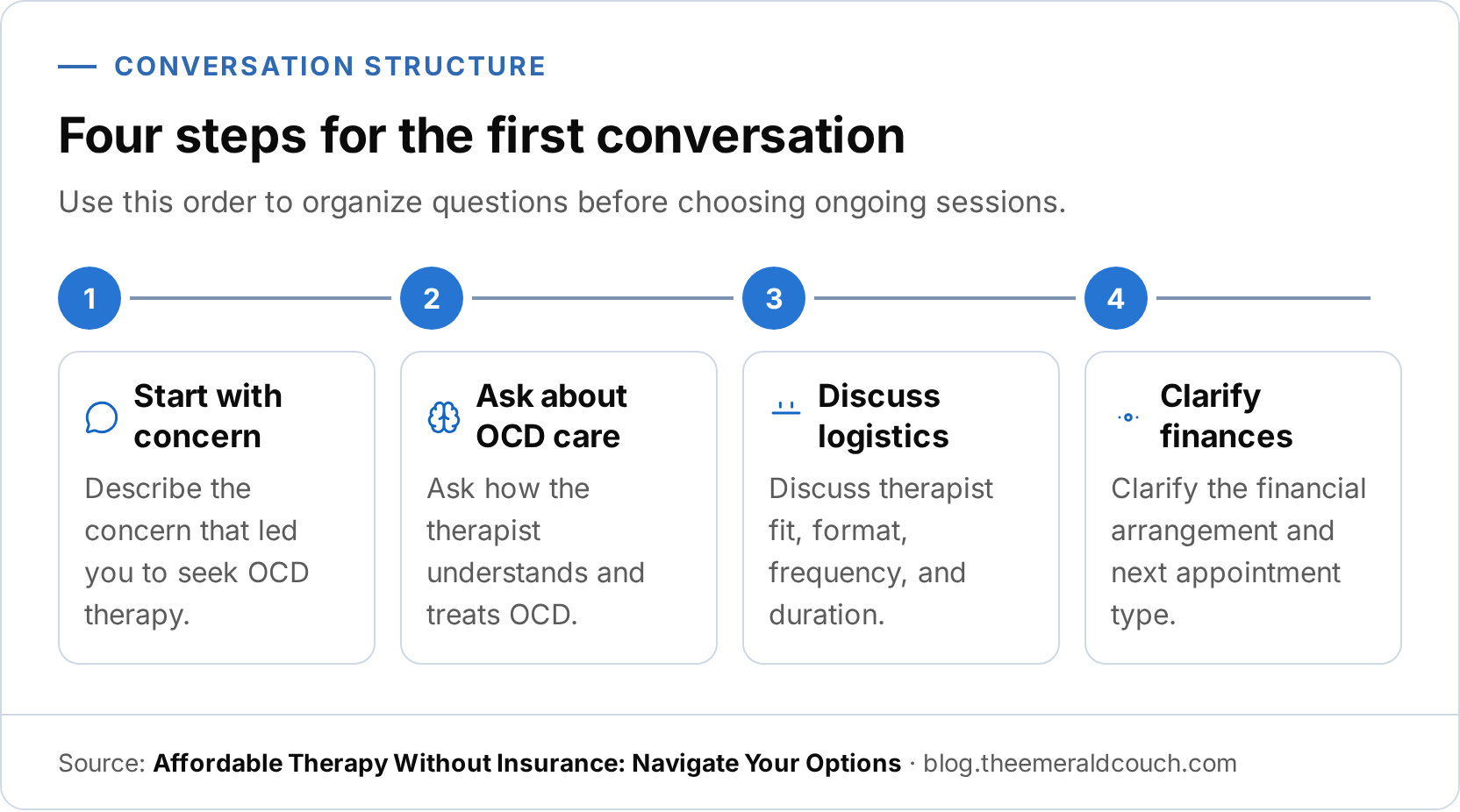
You can organize your list in the order that feels easiest to discuss:
- Start with the concern that led you to look for OCD therapy.
- Ask how the therapist understands and treats OCD, including how ERP enters the discussion.
- Discuss the therapist, format, office logistics, appointment frequency, and session duration.
- Clarify the financial arrangement and the next appointment type.
This structure keeps the conversation practical without turning it into an exam. You are gathering enough information to decide whether you want to continue, while the clinician gathers information relevant to the intake and treatment discussion. After the conversation, use a simple next-step test: proceed to the next appointment only if you understand what it is, who it is with, and which questions remain open. If the next step is unclear, ask for that information before booking. If your main concern is treatment approach, return to the ERP questions; if it is access, return to schedule, format, or cost. This makes the consultation useful even when it does not immediately lead to ongoing sessions. You can use the conversation to gather information and then decide whether the option meets your own requirements.
Confirm cost and insurance before choosing ongoing sessions
Cost and insurance are part of treatment fit, not details to postpone until after you have chosen a therapist. We are in-network with Aetna and Lyra. Our out-of-network rate is $220 a session.
Use those stated details to frame specific financial questions:
- Does your plan apply to the intended OCD therapy service?
- What would your expected responsibility be under the applicable network arrangement?
- If you would use out-of-network care, would the $220 session rate fit your budget?
- Are there payment or claims questions you need to resolve before an ongoing schedule begins?
- Which appointment type and format do the quoted coverage or rate details apply to?
Network status alone does not tell you what your own sessions will cost. Your questions should connect the plan name, the service, the format, and the amount you would pay. If you are using Aetna or Lyra, ask how the arrangement applies to the OCD care you are considering. If you are paying out of network, compare the stated session rate with the amount you can sustain.
Set a financial boundary before choosing a recurring appointment schedule. A treatment option is not a workable option if the cost leaves you unable to continue with the plan you discuss. Ask the financial questions early, record the answers, and keep any unresolved point open before committing to ongoing sessions.
Separate four details when you talk about cost:
- The insurance plan you would use.
- Whether the intended service and format fall under the applicable network arrangement.
- The amount you would pay for a session.
- Any claims, payment, or reimbursement steps that would affect your budget.
This separation helps you avoid treating a network label as a personal cost estimate. It also gives you a clear point at which to pause if the financial arrangement does not fit your circumstances.
Make the contact decision only after the key checks align
The contact decision becomes clearer when the stated OCD focus, face-to-face option, personal fit, schedule, and financial expectations point in the same direction. Before you move forward, use this final check:
- Treatment approach: Can the therapist explain how ERP is used in OCD treatment?
- Therapist fit: Do you feel able to ask questions and discuss your goals openly?
- In-person logistics: Is the Denver office practical for your routine, and is the format available with the clinician you would meet?
- Process: Do you know whether the first step is a consultation, an intake, or another appointment?
- Scheduling: Have you discussed appointment frequency, session duration, and available times?
- Cost: Do you understand whether Aetna, Lyra, or the $220 out-of-network rate applies to the service you are considering?
If those points align, bring the remaining questions to an introductory conversation and ask about current availability, the clinician’s credentials, the exact ERP approach, the appointment pathway, and the financial details. If a key point does not align, pause before choosing ongoing sessions and ask the unresolved question directly.
The goal is not to force a decision from a service page. The goal is to reach a conversation with enough specific information to decide whether this in-person option fits your needs and circumstances.
You can treat the checklist as a decision boundary rather than a score. A strong match on location does not compensate for an unanswered treatment question, and a clear treatment explanation does not resolve a schedule or cost problem. Move forward when the questions that matter most to you have clear enough answers for the next conversation.
If you still have a material concern after the initial discussion, name it plainly. You can ask for clarification about ERP, the clinician, appointment structure, or cost before deciding whether to continue. That keeps the choice connected to your circumstances rather than to proximity alone.
Take the next adult-only step toward a fit conversation
At The Emerald Couch, we work exclusively with adult clients and do not treat younger children. If you are an adult in or near Denver considering in-person OCD therapy, use the questions in this guide to prepare for a focused conversation about ERP, therapist fit, the Denver office, scheduling, cost, and insurance.
Bring your unresolved questions rather than trying to decide everything before you speak with us. When the treatment, personal, and practical checks are ready for that conversation, continue from there.
Sources
- 4 Steps to Realize: I Am Feeling Better Than Before — blog.theemeraldcouch.com, 2026-08-21
- How to find the right therapist — iocdf.org
- About — The Emerald Couch — www.theemeraldcouch.com
- Services — The Emerald Couch — www.google.com
- Key Questions for Your Consultation with a Therapist, Counselor, or Psychologist — The Emerald Couch
- The Emerald Couch